

An agentic QA tool reads your app, decides what's worth testing, writes the test, runs it in a real browser, and rewrites it the next morning after someone renames a button. Autonoma, QA Wolf, Momentic, and testRigor all sell a version of that loop today, and it's fair to conclude that writing and maintaining test scripts has stopped being your job. What the conclusion skips is the agentic QA test data problem sitting one layer down, in the database each of those tests runs against.
None of these tools invents that database. They drive an application that already has to be full of valid, connected, believable rows, and the question of where those rows come from is one every agentic QA product still hands back to the team that bought it. The authoring of the test moved off your plate; the authoring of the data underneath it never did, and the two stay easy to confuse right up until a green suite ships a bug that only a realistic row would have caught. That lower layer has tooling of its own. Seedfast reads the Postgres schema on the connection you hand it and writes fresh values into every column, so the database a QA agent drives comes out connected and valid before the first assertion runs, and one run scopes down to a single table or out to a schema several hundred tables wide. Why the QA vendors leave that job alone is worth a closer look.
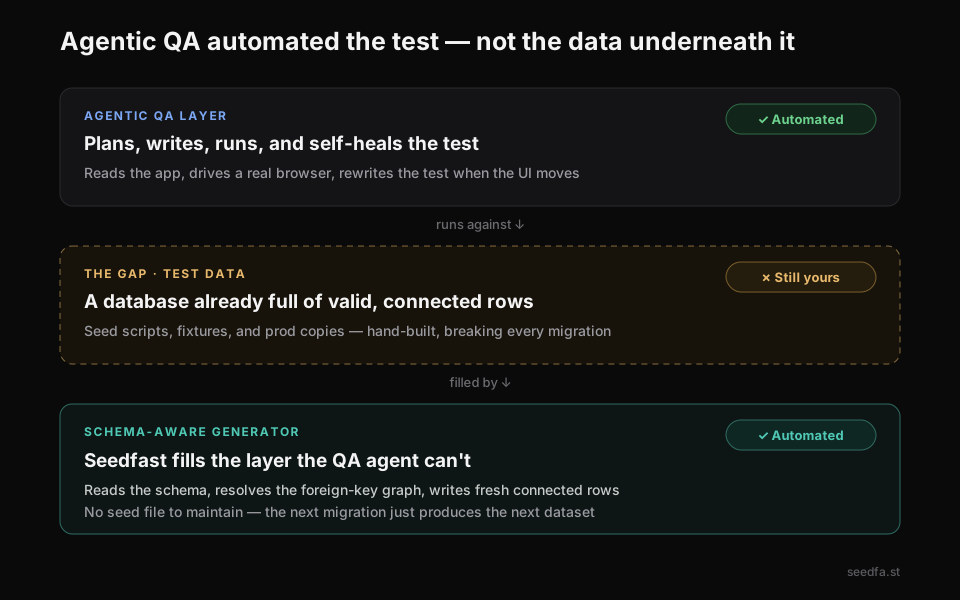
What agentic QA actually automated
For a decade, end-to-end tests were written by hand and broke by hand. An engineer authored a Playwright or Cypress script, a selector shifted, the script went red, and someone lost an afternoon nursing brittle, hand-maintained fixtures back to green. Agentic QA collapses that cycle, and it's worth being specific about how far these products actually go, because they are good at the thing they set out to do.
Autonoma runs the loop as a set of cooperating agents. A Planner reads the app or its codebase and generates the test cases, an Automator drives real browsers to execute them against a live preview environment, and a Maintainer notices when the UI has moved and repairs the affected tests on its own (getautonoma.com, May 2026). QA Wolf takes the managed-service route, generating and running Playwright and Appium suites so that web and native mobile flows both get covered without a team writing the automation code. testRigor lets you describe a test in plain English and compiles that description into a runnable case, which dodges brittle selectors by never asking a human to write one in the first place. Momentic sells the same core promise, an agent that authors and maintains the tests so QA engineers stop babysitting scripts; one agent-market tracker put its total funding at a reported $18.7 million, with Notion, Xero, Webflow, and Retool among its users (agentmarketcap.ai, April 8 2026).
The architectures differ; the shared win doesn't. The test itself, from first intent through running assertion to self-healing upkeep, is now something a team can delegate to software, and that is a real bottleneck cleared.
The step every one of them still hands back to you
Ask any of these tools where the test data comes from and the honest answers converge on the same place, which is you.
Autonoma has the most developed answer in the category, and it deserves a careful description precisely because it's strong. The product ships an Environment Factory, and its own copy is candid about the mechanism. "You connect your own create and delete functions through our SDK", it reads, "so Autonoma seeds and tears down exactly like your app does — password hashing, foreign keys, business rules and all" (getautonoma.com, as of July 2026). Underneath that, per its docs (docs.autonoma.app, as of July 2026), is "one endpoint in your backend that creates isolated test data before each run and tears it down after", so every scenario starts from a clean, correct state. Because the setup runs through your application's own create logic, the rows it produces obey the same invariants production does, which is more than a generic fixture ever gives you, and it's the reason Autonoma's answer is the most credible one going even though it stops short of generating anything at all.
It is also, precisely, not data generation. The Environment Factory calls a function your engineers already wrote, for every entity your tests touch, before the agent can use it — the knowledge of what a valid customer or a well-formed order looks like lives in code your team authored and maintains. Autonoma orchestrates that code well; it doesn't originate the data.
The other tools sit further from generation. A competitor's April 2026 comparison characterizes QA Wolf's database setup as something that "requires coordination with QA team or manual seed scripts" (getautonoma.com, April 2026), which is one vendor's read of a rival and worth treating as positioning. QA Wolf's own page frames a hybrid platform and service, where a team can run the tests itself or lean on QA Wolf's engineers, and neither mode claims schema-driven data generation. testRigor does ship a data feature, and its scope is the tell. The site says it "allows to easily generate unique test data based on specified format or Regex" (testrigor.com/features, 2026). One value, one column, matched to a pattern, with no notion of the foreign key tying that column to the next table over. It's Faker's ceiling relocated inside a test-authoring product, handy for a single field and silent about the graph.
Why doesn't an agentic QA tool just generate the test data itself?
Because it's a different problem, owned by a different kind of software, and none of these vendors is in that business.
A QA agent's competence is behavioral. It models what a user does and reasons about the app's visible surface, the routes and forms and states a browser can reach. Nothing in that job requires it to hold a model of how your schema's tables relate to each other or how your domain's values are really distributed, so it doesn't build one. Momentic's own December 2025 writeup of what its agents do runs from test authoring through maintenance without once mentioning the database underneath the tests (momentic.ai, Dec 29 2025); in that post, at least, the data layer never comes up.
Generating a realistic multi-table dataset is the opposite kind of task, and the steps don't commute: read the schema, satisfy every foreign key and check constraint, then shape the values so they read like production instead of like random(). That's the same constraint-solving problem a language model hits when you ask it to emit the inserts directly, and it's why the sharper question is often which database an agent gets at all. Solving it is a product in itself, and not the product any agentic QA vendor set out to build. It's the one Seedfast did.
Where Seedfast fits underneath an agentic QA tool
The fix isn't to wait for one of these vendors to grow a data engine. It's to put the missing layer directly beneath the one they already automated.
Seedfast is that layer, and it does the thing the QA agent structurally can't. Give it a connection string and it works from the schema on the other end, filling every column and leaving nothing pointed at a row that isn't there, tables that reference themselves or each other included when the schema leaves a nullable link in the loop. None of what it inserts is copied from production. What Seedfast reads is schema metadata, the table and column names and constraints, never the rows inside them, though teams in regulated settings will still want to review what those names reveal. What you get is a database that behaves like production without ever having held a byte of it, standing ready before any agent, QA or coding, runs its first assertion.
Stacked, the division of labor is clean. The agentic QA tool owns the question of whether the app behaves correctly, while Seedfast owns the question of whether the database it behaves against looks anything like production. You seed first and let the agent test second. Run Seedfast as a CLI step in the job that provisions the environment, or, because it also runs as an MCP tool, let a coding agent trigger the seed itself before it hands the app off to the QA layer. A GitHub Copilot agent whose Actions environment comes up empty on every run needs the same seed wired into its setup workflow before a single test has data to run against, because an empty database the agent can't tell is a bug will pass every assertion it runs anyway. Neither tool competes with the other, and neither stands in for it. And because Seedfast is flat-priced rather than metered per row, it costs less than the flaky-suite afternoon it replaces.
Frequently asked questions
What is agentic QA?
Agentic QA is testing where an AI agent plans, writes, runs, and maintains the tests itself, reading the app or its code to decide what to cover, driving a real browser the way a person would rather than binding to fragile CSS selectors, and rewriting a test when the interface it targeted moves. The label is the vendors' own coinage, the phrase Autonoma, QA Wolf, and Momentic all reach for to name their category in 2026 marketing, which is a fair sign of how fast this became a recognized product class.
Does Autonoma generate its own test data?
No, and it doesn't claim to. Autonoma's Environment Factory calls create and delete functions your own engineers write and register through its SDK, which ships for TypeScript, Python, Elixir, Java, Ruby, Rust, Go, and PHP as of July 2026 (docs.autonoma.app). Reusing your app's real logic is why the rows come out valid, but the intelligence that knows what a valid record looks like is yours, not the agent's. It orchestrates your setup code; it doesn't invent data from your schema.
Can testRigor or QA Wolf generate relational test data?
Not in the relational sense. testRigor's data feature tops out at one value matched to a format or regex, useful for filling a field but blind to whether that field has to match a row in another table. QA Wolf describes a hybrid platform and service whose scope covers API setup, database state management, SMS verification, native mobile execution, and multi-user workflows (qawolf.com, 2026); whether a team runs the tests itself or leans on QA Wolf's engineers, nothing in that scope generates relational rows from a schema. Seedfast covers that part, reading the schema and filling the tables in a step that runs before either product opens a browser.
How does Seedfast fit alongside an agentic QA tool?
It runs one layer down and one step earlier. You stand up a throwaway Postgres, run your migrations, and point Seedfast at the connection string to fill it with connected rows, and only then hand that database to the QA agent to test against. Whether the agent is a browser-driving QA tool or a coding agent that seeds itself over MCP first, the sequence holds, and the QA tool never has to care where the rows came from, only that they're present and valid. The free plan needs no card, so evaluating the data layer doesn't require a second procurement conversation.
Where agentic QA test data actually comes from
An agentic QA tool tells you whether your app behaves, but only against the rows it happens to find, and putting realistic rows there was never its job. That gap runs through every vendor in the category, which is why the durable setup stacks two automations instead of waiting for one to absorb the other. Seedfast seeds the database, the QA agent tests it, and neither pretends to do the other's work.
