

The account looks lived-in — forty companies down the sidebar, avatars scattered across a team view, invoices going back six months, the kind of screen you'd happily drop into a pitch deck. Then the prospect clicks into one of those invoices on the call, and the customer it's billed to isn't anywhere in the customer list. Upstream, a demo data generator had filled every table with believable rows and never once checked whether a row in one table points at a row that exists in another.
That specific failure is what this page is about. Filling a database so it reads as real to a human is a different problem from producing a flat file of plausible values, and most tools that surface when you search for a demo data generator solve the second one cleanly while leaving the first untouched. They're genuinely good at the flat file, and they run out of road the moment your demo spans tables that reference each other, which happens on the first click for anything shaped like a real product. Seedfast works from the other end, reading the live schema of the database you're demoing and writing rows into it that already point at each other correctly.
Key Takeaways
- Demo data and test data are different jobs. Demo data has to look coherent to a person watching a screen; test data has to trip the edge cases a CI check reads, and no one will ever look at it.
- The flat generators that rank for this term — Mockaroo, generatedata.com, Beeceptor — fill one table at a time, so foreign keys between tables don't line up. That's fine for a single CSV or a mock API, and a real problem once a demo spans related tables.
- A convincing demo has shape: a few large accounts over a long tail of small ones, signup dates that precede activity, invoice totals that reconcile with their line items.
- "Demo data for a SaaS" is not the same as a sales-demo-automation platform such as Reprise or Demostack. Those personalize the sales pitch itself and are typically a much larger purchase than a data generator.
- Seedfast reads your application's live schema and writes a connected demo dataset across every related table in one run, so an invoice on screen resolves to a customer who exists.
What "demo data" actually means
Demo data is data you load into your own product's database so the thing looks real to whoever is watching it. A prospect clicking through a trial account, an investor sitting through a walkthrough, a new user poking at a sandbox on day one — each of them is judging the product partly on whether its data feels like a real company has been using it. Test data answers a narrower question. It exists to drive assertions, so it cares about the null field, the boundary value, and the one row that makes a CI check go red, and nobody ever admires how it looks.
The two overlap enough that people reach for the same tools for both, then get surprised when a generator tuned for one disappoints at the other. A dataset built to break a pagination bug rarely reads like a tidy sales demo, and one assembled to charm a prospect won't go hunting for the ugly corner your test suite lives for.
One disambiguation is worth making before we go further, because this term pulls two very different searchers. If what you want is software that assembles and personalizes the sales pitch itself — swapping in a prospect's logo, staging a guided product tour, tracking who watched what — that is a sales-demo-automation platform like Reprise, Demostack, or Saleo, and it's a much larger purchase aimed at revenue teams. This page is about the other job of getting realistic rows into your own application's database. If you landed here looking for the pitch-automation category, that's a different shelf entirely.
Why flat row generators break the moment tables relate
Give the incumbents their due first, because they earn it. Mockaroo will hand you a realistic CSV, JSON, or SQL file in under a minute with no install, and it doubles as a mock-API host (per mockaroo.com, as of July 2026). generatedata.com is open-source under the GPL and free to self-host, with roughly thirty data types and a stack of export formats (per the project's GitHub, benkeen/generatedata, as of July 2026). Beeceptor advertises 300-plus field generators and can turn what it produces into a live mock REST API on the spot (per beeceptor.com, as of July 2026). SingleStore ships a basic column-by-column dummy-data widget too (as of July 2026). For a quick single-table export or one faked API response, reaching past any of these would be overkill.
The shared limit is structural, and it isn't a bug in any of them. Each generates one table at a time, with the columns of that table drawn independently. There is no live database in the loop, so nothing connects the value in one table to a value in another.
Watch where that lands on a product. A SaaS demo usually needs organizations that own users, users who hold subscriptions, subscriptions that produce invoices, and invoices backed by usage_events. Generate those five tables in five independent passes and the foreign keys are decorative. An invoice.customer_id is a believable integer that happens to point at no customer you created. Every account ends up on the same subscription tier because nothing wired tier to account. Drill into a single record on screen and the illusion falls apart, which is precisely the interaction a demo is built to invite. The Mockaroo alternative write-up walks through this exact wall in more depth, and the test data generation rundown covers the same tools from the CI-suite angle.
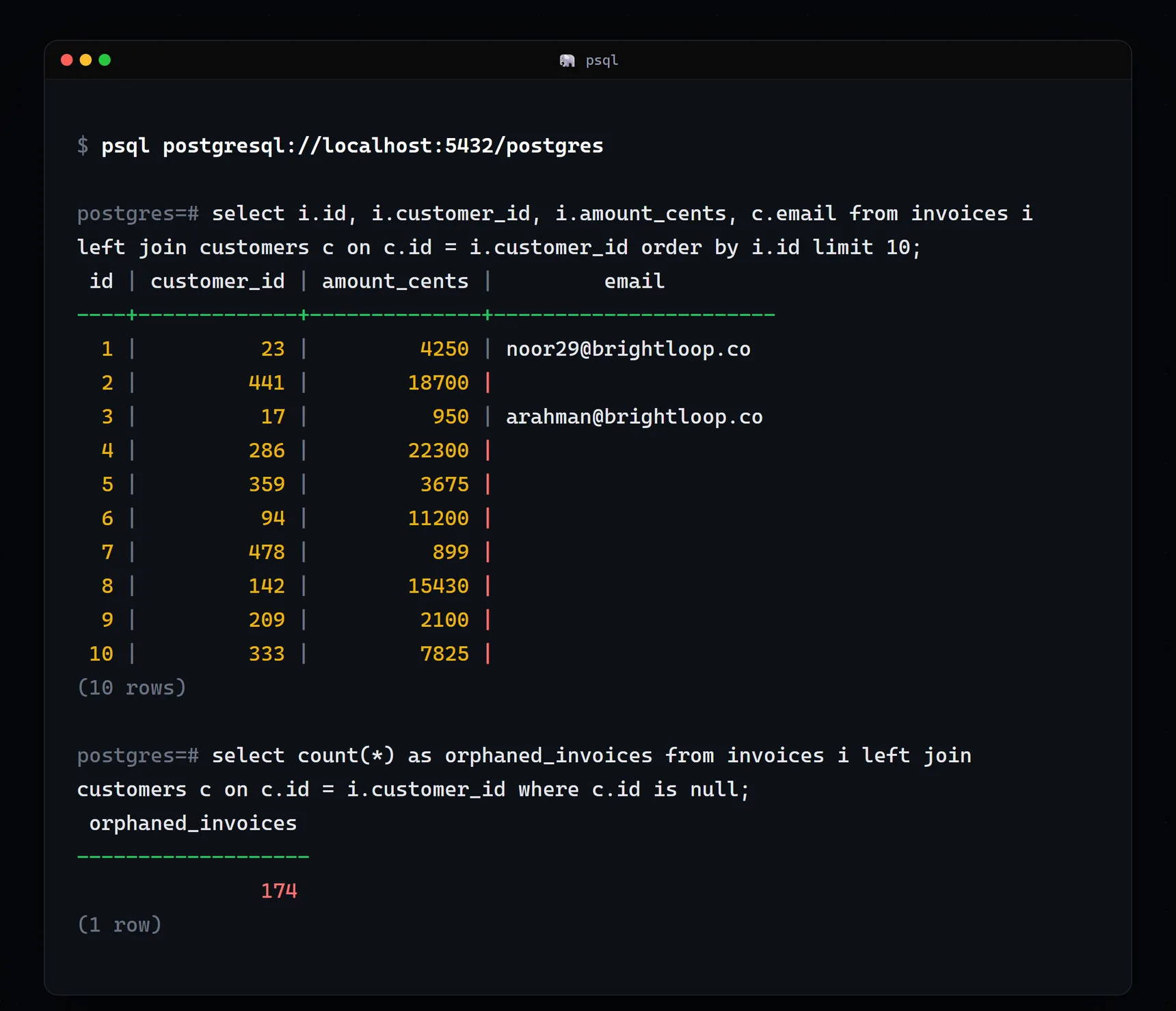
psql makes it countable — in the sample above, eight of the ten invoices bill customers that don't exist, and the orphan count across the whole table comes to 174.
What a demo actually needs to look real
Valid foreign keys are only the floor, and a demo that clears referential integrity can still look obviously synthetic the second someone with domain sense looks at it, because real data carries a shape that random values don't.
Picture the customer list you'd actually want on screen. It would hold a handful of large accounts with dozens of seats and long histories sitting above a long tail of small accounts that signed up last week and barely logged in — not fifty identical companies each with the same three users. Signup dates would land before the first invoice rather than after it, and invoice totals would add up from their line items instead of floating free. None of that is exotic; it's the difference between rows generated with awareness of each other and rows that weren't.
This is the same coherence argument that realistic test data makes for a test suite, turned here to face the person watching. A test only fails when incoherence trips a check it happens to run. The demo has a harsher reviewer in the human watching it, who spots the seams fast, because a customer that predates its own signup or an order with no buyer is exactly the thing a skeptical prospect clicks straight toward.
Generating demo data against your own schema
The way out is to stop generating tables in isolation and start generating from the schema that already defines how they relate. Seedfast runs on that principle. It reads your staging or demo database's live schema on every run, every table and column and type and foreign key in it, then writes a connected dataset across all of them in one pass.
Rows come out referencing each other correctly, so an invoice lands on a customer who exists and a subscription belongs to an account that was created before it. Nothing is left as a flat file to reconcile by hand afterward. You describe the demo you want in plain language and Seedfast fills the tables:
seedfast seed --scope "50 organizations with users, subscriptions, and 6 months of invoices"
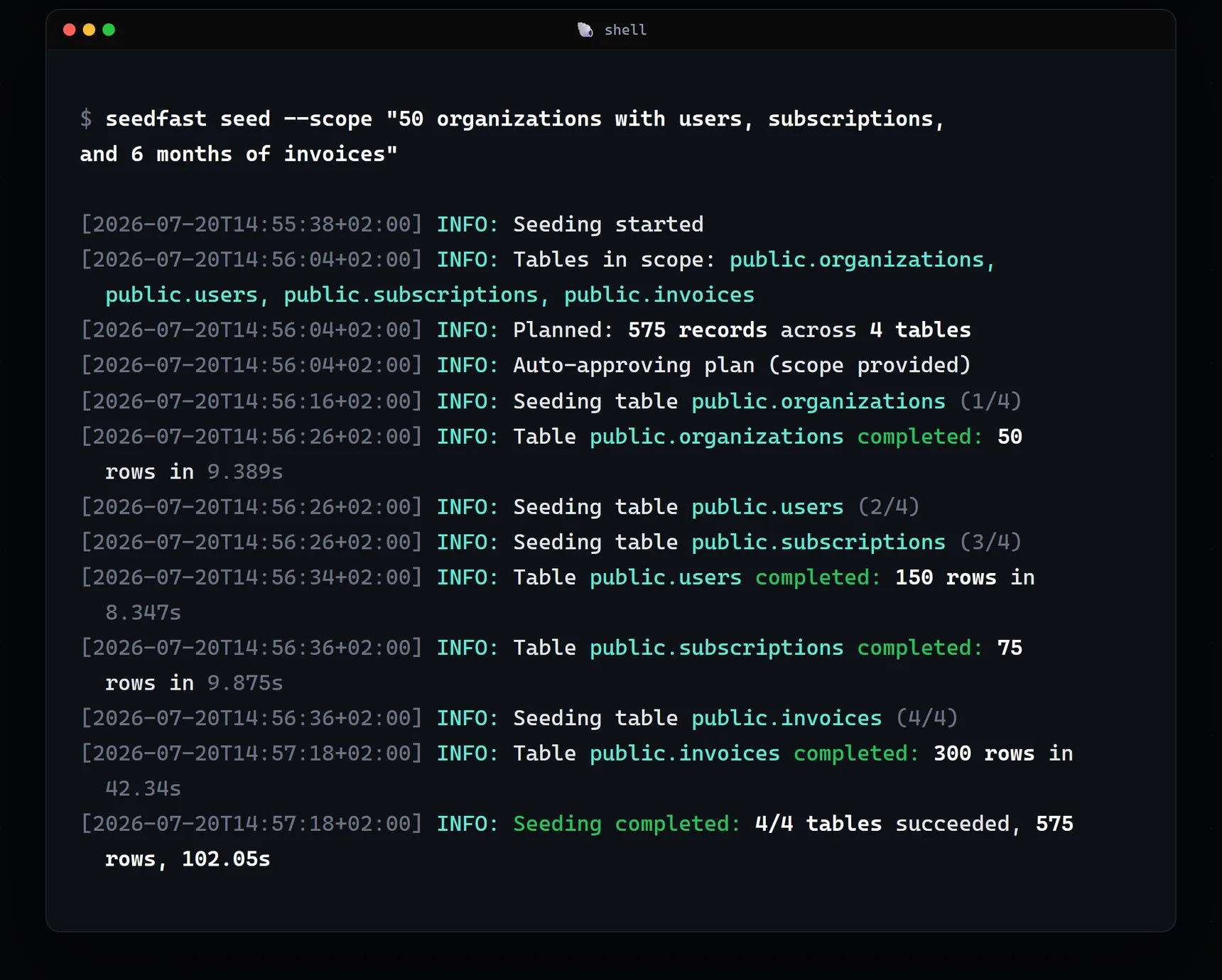
There's no form to fill column by column and no per-table export to stitch back together afterward. Because it reads the schema fresh each time, the migration you ship next week gets picked up on the next run, with no saved definition to quietly break. It runs the same way as a CLI step against a staging connection string or as an MCP server inside an AI coding agent, so the agent building the demo can populate the database itself. There's a free plan that takes no card if you want to point it at a real schema before deciding anything.
Demo data generator options compared
The flat generators win the rows they were built to win, a single fast export or a hosted mock API, while Seedfast takes over once those rows have to agree with each other.
| Capability | Mockaroo | generatedata.com | Beeceptor | Seedfast |
|---|---|---|---|---|
| Reads your live database schema | No | No | No | Yes — on every run |
| Keeps foreign keys valid across tables | Manual — own web form only | Not documented | No | Yes — every child row points at a real parent |
| Multi-table demo in one run | No — one table at a time | No — one table at a time | No — one dataset at a time | Yes — all connected tables together |
| Runs without a live database | Yes — exports files | Yes | Yes | No — needs a connection string |
| Output | CSV, JSON, SQL, Excel | CSV, SQL, JSON, XML, and more | JSON, CSV, SQL, plus a live mock API | Rows written straight into your database |
| Price | Free ≤1,000 rows/file; paid $60–$7,500/yr | Free, open-source (GPL-3.0) | Free tier; no pricing on the tool page | Free plan, then flat monthly credits, no per-row metering |
| Best for | Fastest single flat file or a mock API | Free self-hosted flat exports | Turning generated rows into a mock API | Coherent multi-table demos against your own DB |
Competitor facts verified as of July 2026: Mockaroo pricing per mockaroo.com/pricing; generatedata.com license and feature counts per the benkeen/generatedata GitHub repository; Beeceptor capabilities per beeceptor.com. In my read, all three are the right call when you need one flat table fast, though they become the wrong tool the moment a demo depends on tables referencing each other, which no amount of extra rows fixes.
The quickest check is a run against your own staging schema — that's what the free plan is for.
If you're weighing Mockaroo specifically, the Mockaroo alternative page has the full side-by-side.
Where this fits: trial accounts, staging, investor decks, and QA walkthroughs
The "make it look alive" problem shows up in more places than a sales call. A self-serve trial that greets a new user with an empty dashboard converts worse than one opening on a populated workspace. Investors want enough history behind the charts for them to read as a story, and a QA walkthrough of a new feature lands better against data that resembles a real tenant than against three rows named "Test User". What all of these share is the need for a database that looks used, without a real customer's information anywhere in it.
That last constraint is why a demo environment and a staging environment tend to converge. Both have to look real and neither should be a copy of production. Generating the data from the schema satisfies both at once. Nobody's personal data leaves production, because none of it was ever involved; what the generator does see is schema structure — table and column names — which a regulated team will want to review. And there's no anonymization script to keep in sync as the schema moves.
Frequently asked questions
What is demo data?
Demo data is fabricated data you load into your own application's database so the product looks real to whoever is watching the screen. The bar is visual coherence: names that read like a genuine customer base, dates in a sensible order, and records that connect when someone drills into them — down to the invoice that resolves to a real customer.
What's the difference between demo data and test data?
Test data exists to exercise your code — edge cases, null fields, boundary values, the exact rows an assertion checks — and no one ever looks at it. Demo data exists to be looked at, so it has to hold together as a believable picture even though no test will read it. One generator can serve both, but they pull in different directions, and a dataset tuned to break a pagination bug rarely resembles a clean sales demo. If you actually wanted software that assembles the pitch itself, that's a sales-demo-automation platform like Reprise or Demostack — a separate, pricier category from a data generator.
Can a demo data generator handle foreign keys between tables?
Some can; most can't. The flat generators that dominate this space produce one table at a time, so a foreign key column fills up with plausible integers that don't necessarily match any row you generated in the parent table. Seedfast reads the live database first and writes rows that reference real parents, which is why an invoice belongs to a customer who exists and a subscription belongs to an account created before it. That difference decides whether a demo survives someone clicking into it or only survives a screenshot.
Is Mockaroo good for generating demo data?
For a single flat table, yes — it's the fastest path to a realistic CSV or SQL export, and for mocking one API response it's hard to beat. The boundary appears when a demo needs several tables to agree with each other — Mockaroo generates each table independently and can only relate tables you rebuild by hand in its own web form, not the ones already defined in your database (as of July 2026, per mockaroo.com), so a multi-table demo turns into exporting each file and wiring the keys yourself.
How do I generate demo data for a SaaS product without using real customer data?
Generate it from your schema instead of copying a slice of production. Seedfast connects to a staging or demo database, reads the tables and their relationships, and writes a fresh set of organizations, users, subscriptions, and activity that never belonged to anyone, which means there is no export of real customers and no anonymization pass for anyone to maintain. Because production rows never leave production, there's no PII in the demo to leak. The generator still reads schema metadata like table and column names, so a regulated team should glance at what those names reveal first.
Try it against your own schema
If your demos keep springing leaks on the first click, more realistic-looking columns won't close them. Seedfast reads your live schema and writes a connected dataset across every related table, so the account you show someone holds together when they start clicking. The free plan takes no card, and there's no table or seed ceiling on it to trip over.
Related guides
- Mockaroo alternative — the full side-by-side when your data has foreign keys
- Realistic test data — the coherence argument, aimed at a test suite
- Staging without production data — the same schema-first approach for staging environments
- Test data generation: 7 methods compared — the toolbox when you need CI data, not a demo
