

Search "Tonic.ai alternatives" today and you mostly get directory pages that stack twenty tools in a grid with no sense of which one replaces what. Those lists feel useless because Tonic.ai is not one product. It sells de-identification through Tonic Structural, unstructured-data redaction through Tonic Textual, from-scratch synthetic data through Tonic Fabricate, and bespoke AI-training datasets through Tonic Datasets, which launched in August 2025 (tonic.ai, product lineup as of July 2026).
So "an alternative to Tonic" is really three separate questions sharing one search box, and the right answer depends entirely on which product brought you here. Rather than rank a crowded field, we sort it by the job you're actually doing, naming the credible options for each and saying plainly where our own tool, Seedfast, has no business being on your shortlist. Two of the three jobs below are not ones Seedfast does, and for both we hand you off to the tools that do.
Tonic.ai alternatives, sorted by the job you're doing
Find your job in the list, then read that job's section below. Everything here is current as of July 2026, and each vendor's own page is named the first time a figure appears.
- De-identifying and subsetting production data — the Tonic Structural job. The credible replacements are Delphix, K2view, Datprof, and open-source Greenmask; Neosync also comes up, though its 2025 archival changes that conversation. Seedfast is not built for this.
- Synthetic data for ML training or privacy synthesis — sold through Tonic Fabricate, Tonic Datasets, and Tonic Textual. Look at SDV, YData, MOSTLY AI, or NVIDIA NeMo. Seedfast is not built for this either.
- Populating an application database for development, testing, staging, or demos — the seeding slice of Fabricate usage, and the one place Seedfast fits. Tonic Fabricate stays a strong pick here too, especially for in-browser, exploratory generation.
Name the product you're leaving first and you skip a directory of tools built for a different problem.
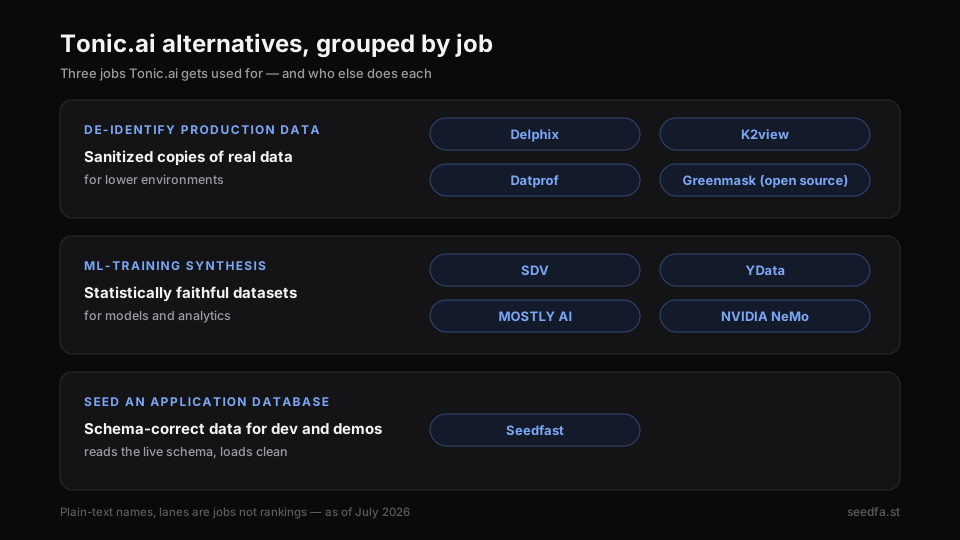
Job 1 — de-identifying production data at enterprise scale
This is the job Tonic Structural exists for — take a production database, mask the personal data, subset it down to a workable size, and provision a safe copy into lower environments. Structural's pricing stays behind a sales quote rather than a public self-serve tier (tonic.ai/pricing, as of July 2026). If it already fits your procurement and passes your compliance review, there's a fair case for staying put; the options below are for teams who want a different vendor, a different price shape, or an open-source path. Seedfast is the wrong category here — it generates fresh rows from a schema and never touches production data — so we leave it out of this section entirely.
Delphix (Perforce). Now part of Perforce, Delphix pairs data virtualization with masking, making lightweight virtual copies of large databases and de-identifying them on the way to dev and test. It's the heavyweight of this tier, aimed at enterprises with many downstream environments and a lot of data to move around, and getting a price means a sales conversation rather than a self-serve checkout (delphix.com, as of July 2026).
K2view. For teams that think in business entities rather than tables, K2view organizes data around a micro-database per customer or order, then masks and provisions those entities on demand. It's entity-based test data management sold into large enterprises, priced only after a sales conversation like the rest of this tier (k2view.com, as of July 2026).
Datprof. Datprof aims a rung down the market from Delphix and K2view — mid-market masking and subsetting with a lighter footprint and a quicker setup for teams that found the enterprise suites heavier than the job needed, and the pricing here follows the same quote-based script (datprof.com, as of July 2026).
Greenmask. If you'd rather stay open-source and you're on Postgres, Greenmask is the active pick. It replaces pg_dump with a masked equivalent, so you connect to production, declare a transformer per column, and get a sanitized dump that loads straight into staging (greenmask.io, open-source, as of July 2026). Structural's core masking is covered here without an enterprise contract, though environment provisioning and orchestration — what the commercial suites hand you outright — becomes your job instead.
Neosync. Neosync used to be the open-source pick for combined masking and sync, but it reads as a cautionary footnote now rather than a live option — the project was acquired and its repository archived in 2025. We wrote up where its users are landing in the Neosync alternative guide; for the masking half of what it did, Greenmask above is the closest actively maintained replacement.
Job 2 — synthetic data for ML training and privacy synthesis
The second question hiding inside "alternative to Tonic" is about synthesis for models, meaning data that reproduces the statistical shape and rare cases of a real dataset well enough to train, fine-tune, or evaluate on, without carrying real records forward. Tonic sells this through Fabricate and Tonic Datasets (bespoke training datasets, launched August 2025), plus Textual for unstructured text. Judged against this job, Seedfast comes up empty — it's built to make a schema boot, not to reproduce a dataset's statistical shape, and putting it on an ML shortlist would cost you time rather than save it. Here's where we'd look instead.
SDV (Synthetic Data Vault). SDV is the open-source anchor of this list, an MIT-licensed Python library for tabular, relational, and time-series synthesis that you self-host and run in a notebook (sdv.dev, as of July 2026). You give up a managed platform and take on the operational burden yourself, which is the right trade when you have engineering time and a synthesis task you already understand.
YData. Closest to a notebook-first workflow is YData, which keeps an open core (the ydata-synthetic lineage) beneath a commercial platform called Fabric for teams that want the managed version (ydata.ai, as of July 2026). If living inside a Python environment was what you liked, this is the least jarring move.
MOSTLY AI. On the commercial, fidelity-first end sits MOSTLY AI, which pairs a managed platform for tabular synthesis with an open-source Synthetic Data SDK (mostly.ai, as of July 2026), letting you prototype in code before deciding whether the hosted product earns its keep. It's the one to price when a vendor relationship matters more to you than self-hosting.
NVIDIA NeMo (Data Designer and Safe Synthesizer). The technology formerly sold as Gretel now ships inside NVIDIA NeMo as the Data Designer and Safe Synthesizer microservices, distributed through NVIDIA AI Enterprise with sales-gated pricing (nvidia.com/en-us/ai-data-science/products/nemo, as of July 2026). If you arrived here after Gretel's self-serve tier disappeared, our Gretel alternative guide maps that migration in full.
Job 3 — populating an application database (where Seedfast fits)
The third job is the one people don't always realize is separate. A lot of Fabricate usage is really database seeding — someone needs a dev, test, staging, or demo database full of connected rows, and a synthetic-data tool happened to be the thing already open. Statistical fidelity isn't the standard here — what matters is whether the data holds together, every foreign key resolving to a row that exists, unique constraints intact, NOT NULL columns filled, so the application boots on the first insert instead of throwing. Seedfast is built around exactly that answer.
Point it at your database, describe the scenario in plain English, and Seedfast reads the live schema on that run and generates a connected dataset satisfying the constraints it finds, with no relationships left for you to wire up. Seedfast requires no production access to do it, since the rows are generated rather than copied from a real dataset. Because one CLI command is the whole surface, Seedfast drops into CI right after your migrations, and the same run is exposed as an MCP tool so an AI coding agent in Claude Code or Cursor can seed a database inside the conversation. Seedfast charges a monthly plan that includes a pool of credits, $16 a month for $32 of credits or $69 for $180, and under both there is a free plan that takes no card and puts back $5 of credits a month.
seedfast seed --scope "a b2b billing app with 80 customers, invoices in three currencies, and an overdue-payment queue"
Two honest concessions keep this fair. Seedfast is Postgres-first today, whereas Fabricate generates into Postgres, MySQL, Oracle, and Databricks, so when your seeding spans engines Fabricate covers ground Seedfast doesn't. And Fabricate's interactive web-and-chat surface is genuinely good for poking at a dataset in a browser, which a headless CLI isn't trying to be. Fabricate's published pricing reflects that interactive model — a free plan whose credits vary by signup email ($5 a month of credits with a restricted model set on a personal email, $10 with all available models on a work email), a Plus plan at $29 a month plus $25 of monthly credits, and per-turn metering beyond that (tonic.ai/pricing, as of July 2026). Whether a credit-pool plan or a metered one fits depends on how often you seed; the test data tool pricing comparison lays both models side by side, and for a feature-by-feature look at the two seeding workflows there's Seedfast vs Tonic Fabricate.
If you want the wider category — DIY scripts, web generators, masking tools, and schema-aware seeders next to each other — the data seeding tools guide covers the field.
The ten options at a glance
No ranking is implied by the order here — each row answers to its own job, and a tool built for someone else's problem is not a worse tool. Details are current as of July 2026.
| Tool | Job it fits | Delivery | Self-serve today? | Pricing |
|---|---|---|---|---|
| Delphix | De-identification | Virtualization + masking | No — sales | Quote-based |
| K2view | De-identification (entity TDM) | Enterprise platform | No — sales | Quote-based |
| Datprof | De-identification (mid-market) | Masking + subsetting | No — sales | Quote-based |
| Greenmask | De-identification (Postgres) | OSS CLI, pg_dump-style | Yes (self-host) | Open-source |
| Neosync | De-identification (archived) | OSS, unmaintained | No — archived 2025 | n/a |
| SDV | ML-training synthesis | Python library | Yes (self-host) | MIT, free |
| YData | ML-training synthesis | Library + platform | Open lib + managed | Open core, paid Fabric |
| MOSTLY AI | ML-training synthesis | Platform + Python SDK | Yes (SDK is open source) | Open-source SDK; platform commercial |
| NVIDIA NeMo | ML-training synthesis | NeMo microservices | No — sales | AI Enterprise, sales-gated |
| Seedfast | App-database seeding | CLI + MCP server | Yes | $16/$69 mo, credit pool, free plan |
Find your job in the middle column, and the one-or-two rows that share it are your real shortlist. The rest are answering a different question well.
Frequently asked questions
Is there a free Tonic.ai alternative?
That depends on the job. The open-source tools are free as in no license fee — Greenmask for Postgres masking, SDV for ML synthesis — with the operational work moved onto you. For app-database seeding, Seedfast has a permanent free plan that takes no card and refills to $5 of credits each month. And if you're staying in the Tonic ecosystem, Fabricate's own free plan (credits that vary by signup email, tonic.ai/pricing, as of July 2026) is a fourth path worth knowing about.
Is there an open-source alternative to Tonic?
Yes, though again it splits by job. Greenmask is the actively maintained masking option for Postgres. ML synthesis splits between MIT-licensed SDV and YData, which ships an open core beneath its commercial platform. We found no open-source tool as of July 2026 that matches Structural's full enterprise provisioning at scale — the OSS projects cover the core masking or generation, not the environment orchestration a large team leans on.
What's the best alternative to Tonic Structural specifically?
For enterprise de-identification and provisioning, Delphix and K2view are the closest like-for-like. Datprof fits when the enterprise suites are heavier than the job needs, and Greenmask fits when you want open-source and you're on Postgres. In our reading the deciding factor is scale — how many environments you provision and how much data you move — rather than any single feature checkbox.
I need data for a dev or test database, not for training a model. Which one?
That's the seeding job, and Seedfast handles exactly that one. Pointed at a Postgres database, Seedfast turns a plain-English scenario into a dataset whose references all resolve to rows that exist, and the same command runs unattended as one CI step after your migrations. Tonic Fabricate covers this job too and is the stronger choice for in-browser exploration or for the non-Postgres engines it supports. If you're weighing the two, the head-to-head linked earlier walks the workflows feature by feature.
Which Tonic product am I actually replacing?
Structural handles de-identifying production data — that's Job 1. Job 2 belongs to Fabricate, Textual, and Tonic Datasets, covering synthetic and unstructured data for models. If you were reaching for Fabricate to fill a development database, that's the seeding job (Job 3), and it's the single place Seedfast belongs. Naming the product first spares you a shortlist of tools designed for a different problem.
Start from the product, not the tool list
The reason "Tonic.ai alternatives" returns noise is that it folds three different shopping trips into one search box. Name the Tonic product you're leaving and the shortlist shrinks to something you can evaluate in an afternoon instead of a grid of twenty tools solving unrelated problems.
Most of what lands on this page isn't Seedfast's job, and the sections above hand you off without a pitch. Where a development, test, or staging database needs connected, schema-valid rows, Seedfast is the one thing here built for the job. Seedfast needs a connection string and one sentence of scenario, and the rows are in your tables a few minutes later, with the exact commands in the getting-started walkthrough. Monthly plans, each with its own pool of credits included, sit on the pricing page next to the free plan, which never asks for card details.