
Gretel Was Absorbed Into NVIDIA. A Migration Path for Self-Serve Users
 By Mikhail Shytsko, Founder at Seedfast ·
You went looking for a Gretel alternative, typed gretel.ai into the browser, and landed on nvidia.com. That redirect is the short version of what happened. NVIDIA acquired Gretel in March 2025 — reported at somewhere north of $320 million — and over the following year the self-serve product developers used to sign up for on their own got folded into NVIDIA's enterprise stack. Nobody sent the free-tier and self-serve accounts a migration plan. This is that plan, and it splits by what you were actually using Gretel for, because two different jobs hid under one login.
TL;DR — Gretel's self-serve synthetic-data platform is effectively discontinued after the NVIDIA acquisition. As of July 2026, gretel.ai redirects to nvidia.com, the gretelai GitHub organization is archived, and the old pricing page returns a 404. The technology now ships inside NVIDIA NeMo (Data Designer and Safe Synthesizer microservices), licensed through NVIDIA AI Enterprise with no public pricing. Were you generating synthetic data for ML training or privacy? Your like-for-like replacements are Tonic, YData, the open-source SDV, or NeMo itself. Were you filling an application database for development, testing, or demos? That is a different job, and the one Seedfast is built for.
- NVIDIA acquired Gretel in March 2025 (reported above $320M). As of July 2026, gretel.ai 301-redirects to nvidia.com, the
gretelaiorg's repositories are archived (read-only), and the legacy/pricingpage returns a 404. - The old self-serve free tier — a modest monthly credit allowance — has been discontinued. No public sign-up flow remains for the standalone product.
- Gretel's technology was absorbed into NVIDIA NeMo as the Data Designer and Safe Synthesizer microservices, available through NVIDIA AI Enterprise. Pricing is sales-gated, so there is no self-serve tier replacing the one you lost.
- Which Gretel alternative is right depends entirely on the job you ran it for. Model-training and privacy-synthesis users should evaluate Tonic, YData, SDV, or NeMo. Teams that used Gretel to fill an application database want a schema-aware seeding tool instead.
- Seedfast covers that second job. Point it at your application's database, describe the data you want in plain English, and it reads the live schema and generates connected, referentially consistent rows. Pricing is flat monthly, and the 30-day free trial never asks for a card.
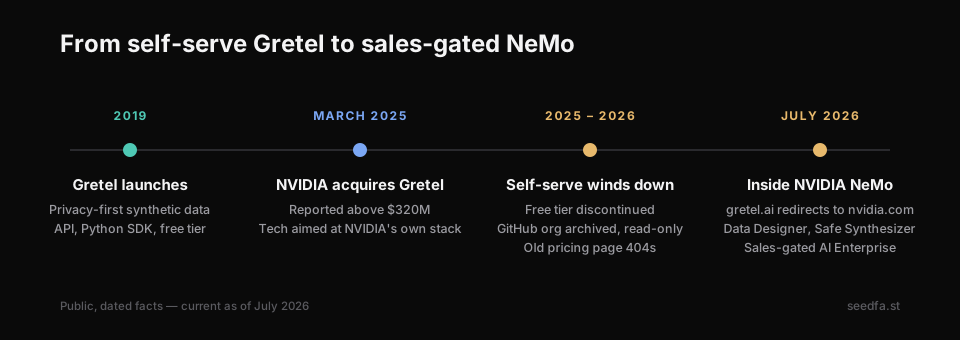
Gretel launched in 2019 around one promise, privacy-preserving synthetic data. Train a model on a sensitive dataset, generate a synthetic version that keeps the statistical shape without carrying real records forward, and hand that safe copy to whoever needs it. Developers took to it because you could try it without a sales call — there was an API, a Python SDK, and a free tier that let you kick the tires before committing a budget.
NVIDIA announced the acquisition in March 2025. Reporting at the time put the deal above $320 million, and NVIDIA was direct about the intent. Gretel's synthetic-data technology would power its own AI platform rather than continue as an independent self-serve product, and that is how the next year played out.
Here is where things stand as of July 2026. The signals are easy to miss one at a time, so it helps to see them together:
- gretel.ai redirects to nvidia.com. The standalone marketing site is gone; the domain now points at NVIDIA.
- The
gretelaiorg's repositories are archived (read-only). You can still clone the SDK and example repos, but nothing new gets merged into them. - The old pricing page 404s. With no self-serve plan page, there is no free tier and no way to start a fresh paid subscription on your own.
- The technology moved into NVIDIA NeMo. Gretel's capabilities re-emerged as two NeMo microservices — Data Designer for synthetic dataset generation, Safe Synthesizer for privacy-preserving synthesis — distributed under NVIDIA AI Enterprise.
This is not the Snaplet Seed alternative situation, where a company wound down and open-sourced the code on its way out the door. Gretel was absorbed instead, so the technology arguably sits in a bigger, better-funded home now. What changed for a self-serve user is narrower and more annoying than a shutdown. That bigger home just does not sell to you the way Gretel did.
The honest framing is not "Gretel is dead" — the underlying technology is very much alive inside NVIDIA. The question that matters to you is whether the thing you depended on still exists in a form you can actually reach, and for self-serve accounts the answer is mostly no. A few risks are concrete enough to plan around.
New self-serve sign-ups are closed. If your team was going to add seats or spin up a new project on the old free tier, that path no longer exists. Onboarding a new hire onto Gretel the way you did in 2024 is not an option in 2026.
The free tier is discontinued. The credit-based free plan that made Gretel easy to adopt is not coming back. NVIDIA AI Enterprise licensing is the replacement, and it starts with a conversation rather than a credit card.
The SDK is frozen. Because the gretelai GitHub org is archived, the open-source client you may still have pinned in requirements.txt will not get patches. It runs until a dependency bump or a Python release breaks it, and then it stays broken.
Hosted endpoints carry sunset risk. If any of your pipelines still call a legacy Gretel Cloud endpoint, treat that as borrowed time. Post-acquisition APIs get deprecated on the acquirer's schedule, not yours, and rarely with generous notice. Anything running in CI against a hosted Gretel call is a good candidate to migrate before it fails on its own.
Support moved upmarket. The help a self-serve user got — docs, a community, a responsive issue tracker — is now enterprise support attached to a license, which suits a large team standardizing on NVIDIA and does little for a solo developer who wanted an API key and a quickstart.
None of these is an emergency on its own, but together they mean the product you evaluated is not the product you can buy today, so it is worth choosing where you go next deliberately rather than waiting for a broken build to force the decision.
Gretel wore two hats, and the correct replacement is different for each one. Before you shortlist anything, work out which hat you were wearing, because picking a tool for the wrong job is how teams end up paying for capabilities they never touch.
The distinction is the same one that separates model-training data from application test data. Model-training data answers to statistical fidelity — the output has to reproduce the distributions and rare cases of a real dataset well enough to train on. Correctness is what application data answers to instead — every foreign key pointing at a row that exists, unique constraints holding, required columns filled, so the app boots instead of throwing on the first insert. A tool tuned for one is rarely much good at the other, and Gretel's heartland was firmly the first.
If your data was for training, fine-tuning, or evaluating a model, or for handing a de-identified copy of a sensitive dataset to another team, keep reading the ML-training section below; if it was for filling a development, test, staging, or demo database your software runs against, skip to the application-database section — the job Gretel was always overkill for.
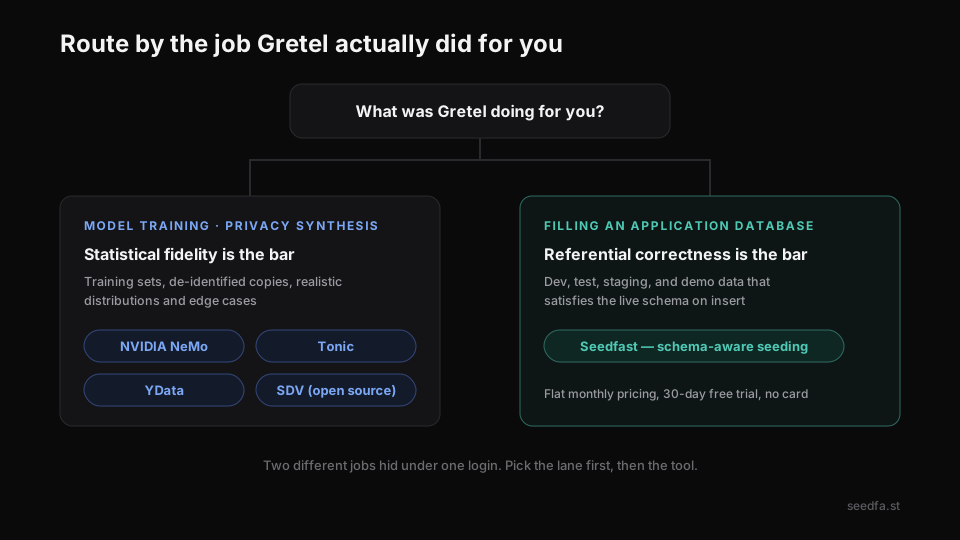
Say your Gretel usage was genuinely about models and privacy, whether that meant synthesizing a training set, standing in for data you could not share, or evaluating on realistic-but-fake records. These options land closest to what you had, and every claim here is dated to July 2026 because this market moves fast.
NVIDIA NeMo (Data Designer + Safe Synthesizer). This is the literal continuation of Gretel's technology, so an organization already on NVIDIA AI Enterprise, or willing to get there, will find it the least-surprising destination — same lineage, more compute behind it. What you pay for is the shape of the relationship, now a licensed enterprise product with sales-gated pricing rather than an API key you provision yourself.
Tonic. On the commercial side, Tonic pairs synthesis with de-identification. Its Structural product masks and transforms production data, while Fabricate generates synthetic data from a schema, and there is a live-connect path to production for teams that want it. In our reading it is the most enterprise-ready swap if you want a vendor relationship without NVIDIA's licensing, and it covers more database engines than most single-purpose tools.
YData. Being Python-native, YData sits closest in spirit to Gretel's SDK-first workflow. The open ydata-synthetic library plus the commercial Fabric platform give you a self-hostable path and a managed one, so teams that liked living inside a notebook with Gretel tend to feel at home here.
SDV (Synthetic Data Vault). SDV is the open-source route on this list, an MIT-licensed Python library for tabular, relational, and time-series synthesis. You self-host and pay nothing in license fees, though you own the operational burden yourself. If your Gretel bill was the thing that hurt and you have the engineering time, this is where we would start.
For a broader survey of the AI-synthesis field and where each tool's strengths actually lie, the best AI test data generator guide lays out the model-fidelity camp against the schema-correctness camp in detail. The short version is that if you are training a model, one of the four above is your Gretel alternative and Seedfast is not, because it does not try to reproduce a distribution and has no business on that shortlist.
The other group never used Gretel to train anything; plenty of teams reached for it to get realistic-looking data into a dev, test, or staging database — a synthetic-data tool pressed into service as a database seeder. That works on a toy schema and stops the moment the schema has forty tables and real foreign keys, because a fidelity-first synthesizer produces rows that look plausible on their own and then fail on insert when order.customer_id points at a customer nobody generated. The bar here was never distributional realism but whether the data holds together well enough for the app to run.
Seedfast is built for exactly that. You connect it to your application's database, it reads the live schema, and it generates a connected dataset that satisfies the constraints it finds — no hand-wiring of relationships, no synthetic-fidelity model to train, no production data leaving your database. Where Gretel asked "how close is this to the real distribution," Seedfast asks "does this populate the schema you actually have," which is the question a seeded dev or CI database needs answered.
# Point Seedfast at your database and describe what you want
seedfast connect
seedfast seed --scope "50 users, each with 3 projects and a handful of tasks, plus one admin account"
There is no model to fit and no export step. The scope is a sentence and the schema supplies the structure, so the rows come out connected. When a migration changes the schema, the next seedfast seed reads the new shape — there is no generation script pinned to yesterday's tables. If you are new to the category itself, the database seeding guide walks through why hand-maintained seed files break and what reading the schema fixes.
A few things matter to the specific person who is here because Gretel left:
- It fits AI coding agents. Seedfast ships an MCP server, so if you work in Claude Code, Cursor, or another MCP-aware assistant, the agent can seed a database inside the conversation instead of you shelling out. Gretel never offered that, and given its timeline it never would have.
- It runs in CI. A single
seedfast seedstep after your migrations gives every pipeline run the same starting data, with an API key for non-interactive auth. No hosted-endpoint sunset to worry about, because the tool is doing seeding, not standing up a synthesis service you have to keep alive. - The pricing is flat and self-serve — the thing you just lost. Seedfast is $8, $12, or $16 a month depending on scale, with a 30-day free trial that does not ask for a card. After Gretel's move to sales-gated licensing, being able to sign up and seed a database the same afternoon is most of the point. The pricing page has the current plan breakdown, and if you are weighing flat-rate against metered or quote-gated tools, the test data tool pricing comparison sets them side by side.
Seedfast is PostgreSQL-first today and reads whatever ORM defined your schema — Prisma, Drizzle, TypeORM, Django, Rails, or raw SQL all work the same way, because it talks to the database rather than the ORM. For a category-level look at where schema-aware seeding sits next to masking, DIY scripts, and web generators, the data seeding tools comparison covers the field.
The table below sorts the options by the job they actually do. Read it as a routing aid, not a scoreboard, because a tool being wrong for your job is not a tool being bad. Details are current as of July 2026.
| Tool | Primary job | Delivery | Self-serve today? | Pricing |
|---|---|---|---|---|
| Gretel (legacy) | ML-training + privacy synthesis | API / Python SDK | No — discontinued | Free tier removed |
| NVIDIA NeMo | ML-training + privacy synthesis | NeMo microservices | No | NVIDIA AI Enterprise, sales-gated |
| Tonic | Synthesis + de-identification | SaaS + live connect | Fabricate: yes (credit-based); Structural: sales | Fabricate credits; Structural quote-based |
| YData | Model-training synthetic data | Python library + platform | Open lib + managed | Open-source core, paid Fabric |
| SDV | Tabular/relational synthesis | Python library | Yes (self-host) | MIT, free |
| Seedfast | Application database seeding | CLI + MCP server | Yes | Flat $8/$12/$16 mo, 30-day trial |
If your row is one of the top four, you are in the model-training lane and one of them is your like-for-like Gretel replacement. If the job was filling an application database, Seedfast is the bottom row for a reason, since it is the only one on the list whose whole design goal is a schema that boots.
Is Gretel shutting down?
Not in the usual sense of a company closing its doors. Gretel was acquired by NVIDIA in March 2025, and as of July 2026 the standalone self-serve product is discontinued — gretel.ai redirects to nvidia.com and the old pricing page 404s. The technology itself continues inside NVIDIA NeMo. So the code lives on; the product you could sign up for on your own does not.
Is there still a Gretel free tier?
No. The legacy free tier — a limited allotment of credits each month — has been discontinued, and there is no public sign-up flow left for the standalone product. Access now runs through NVIDIA AI Enterprise, which is sales-gated and has no self-serve free plan. If a no-card starting point is what you are after, an actively self-serve tool like Seedfast (30-day free trial) or the open-source SDV library is the closer match.
What replaced Gretel?
Inside NVIDIA, Gretel's technology became two NeMo microservices, Data Designer for synthetic dataset generation and Safe Synthesizer for privacy-preserving synthesis, both under NVIDIA AI Enterprise. As a standalone product it was not replaced by NVIDIA with anything self-serve, which is why the market answer depends on your use case — Tonic, YData, or SDV for model-training data, and a schema-aware seeder like Seedfast for application-database data.
Is the Gretel SDK or API still usable?
The open-source SDK still installs, but the gretelai org's repositories are archived and read-only, so it is frozen and receiving no patches — plan on it breaking whenever a dependency or Python version moves under it. Any hosted Gretel Cloud endpoints your pipelines still call should be treated as sunset risk; acquirers deprecate legacy APIs on their own timeline. Migrating those calls before they fail is cheaper than debugging them after.
What is the best Gretel alternative for test data?
For getting realistic data into an application database — the development, test, staging, and demo use case — we would point you at a schema-aware seeding tool rather than another synthetic-data platform. Seedfast reads your live schema and generates connected, referentially consistent rows from a plain-English scope, runs in CI, and has flat self-serve pricing. If your "test data" is actually model-training data, that is a different job and SDV, YData, or Tonic fit better.
The awkward part of an acquisition like this is that nothing technically broke — your last Gretel run still sits in a folder somewhere, and the SDK still imports. What broke is the ability to keep buying it on your own terms, which surfaces the day you try to add a project or a teammate. Sorting into the right lane now keeps the migration small. Teams training or evaluating models can land on NeMo, Tonic, YData, or SDV, and the best AI test data generator guide compares them properly. To fill an application database so your dev and CI environments have something to run against, connect Seedfast, describe a scenario, and the first dataset lands in the five-minute getting-started flow. The trial runs 30 days on your own schema without a card, roughly what Gretel's free tier used to offer, now pointed at the job most people were quietly using it for.
Seedfast is not affiliated with, endorsed by, or sponsored by the products compared here. All product names, logos, and brands are the property of their respective owners and are used for identification purposes only. Comparisons reflect publicly available information as of the date shown.
Gretel, NVIDIA, Tonic, YData, SDV, MOSTLY AI are trademarks of their respective owners.