

Your coding agent is connected, the migrations have run, and the database behind them is empty. Ask around for an MCP server to fix that and the shelf looks crowded — mcpservers.org lists more than 870 in its database category alone (mcpservers.org/category/database) — but almost none of them do the job you're picturing. They hand the agent a way to run SQL against data that already exists. What you actually want, MCP test data, is the opposite errand, a server that puts realistic, connected rows into a schema that currently holds none.
This page surveys the servers that do that, and the much larger category that doesn't, so you can tell one from the other before wiring anything into an agent that can write to your database. It reflects a landscape where the "which MCP gives my agent test data" shelf is still surprisingly thin.
Access or generation? The line that splits the category
Here is the distinction that decides everything downstream. A database-access MCP lets an agent run SQL against data that already exists, inspecting tables, reading schemas, executing queries, and sometimes writing individual rows. A test-data MCP generates the realistic, relationally consistent data in the first place and writes it into the schema. Against an empty database the access kind is useless, since there's nothing there to query, and the generation kind is what fills it. Seedfast sits on the generation side, reading the live schema through the connection you hand it and writing the rows in place.
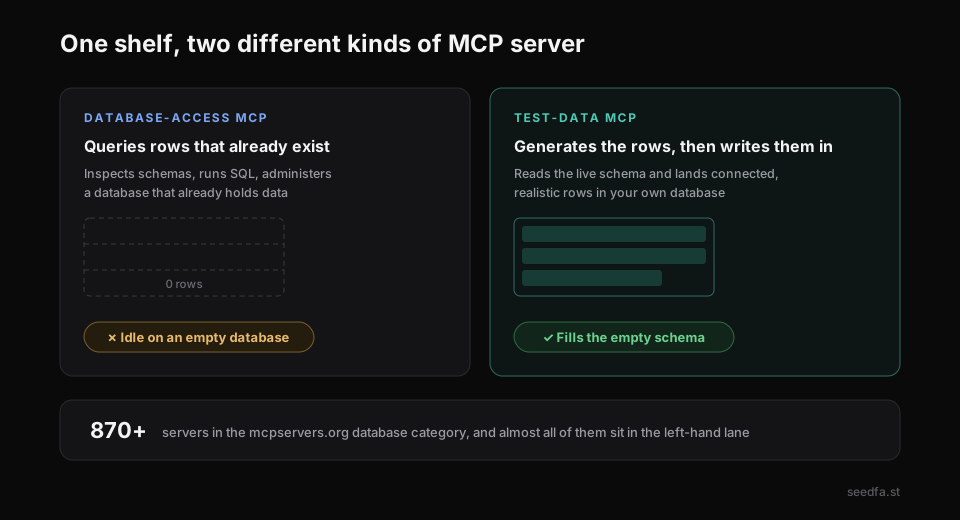
Most of those 870-plus database servers are the first kind. Point one at a fresh container or a just-migrated branch and it sits idle, because a query needs rows to return and there aren't any. You could skip the MCP entirely and ask the agent to write the INSERT statements itself, which works right up until the foreign keys have to line up across a dozen tables — the point where model-written seed SQL tends to come apart, walked through in the generate test data with AI playbook.
MCP test data servers at a glance
Four options cover almost everyone reading this, and the table below sorts them by what they actually put in your database, not by how they market it.
| MCP server | What it does | Pricing model | Best for |
|---|---|---|---|
| Seedfast MCP | Generates connected, realistic rows and writes them into your own database in place, from one seedfast_run call | Monthly credits (free plan, then $16 / $69), no per-token meter | Seeding your own Postgres, Supabase, or Neon from an agent or CI |
| Tonic Fabricate MCP | Bridges Claude or Cursor to Fabricate's hosted generation agent, which synthesizes data across several engines | Plan + credit/token metering (Plus $29/mo, as of July 2026) | Interactive, multi-engine generation from the editor |
| SeedBase Test Data (OSS) | FK-consistent data generator, open source | Free (open source) | Self-hosted setups and OSS-only shops |
| Database-access MCPs (Oracle, Microsoft SQL, Cloudflare D1, DBmaestro, Salesforce) | Let an agent query and administer data that already exists; do not generate it | Free or bundled with the platform | Inspecting, querying, or operating a database that already has rows |
Generation lives in the top two rows. Everything below only reads data that already exists, which is why that one split matters more than any feature comparison you could run inside either camp.
Seedfast MCP seeds your database in place
Seedfast runs as an MCP server that a coding agent launches over the Model Context Protocol and then calls with a single tool, seedfast_run. You describe the data you need in plain language, it reads your live schema, and it writes realistic rows into the database you're already connected to, with the foreign keys resolving so the rows genuinely hang together rather than pointing at records that were never created. Nothing gets shipped out to a hosted service and loaded back afterward; the data lands directly in your own Postgres, whether that's a Supabase branch, a Neon branch, an RDS instance, or a throwaway container spun up for a test run.
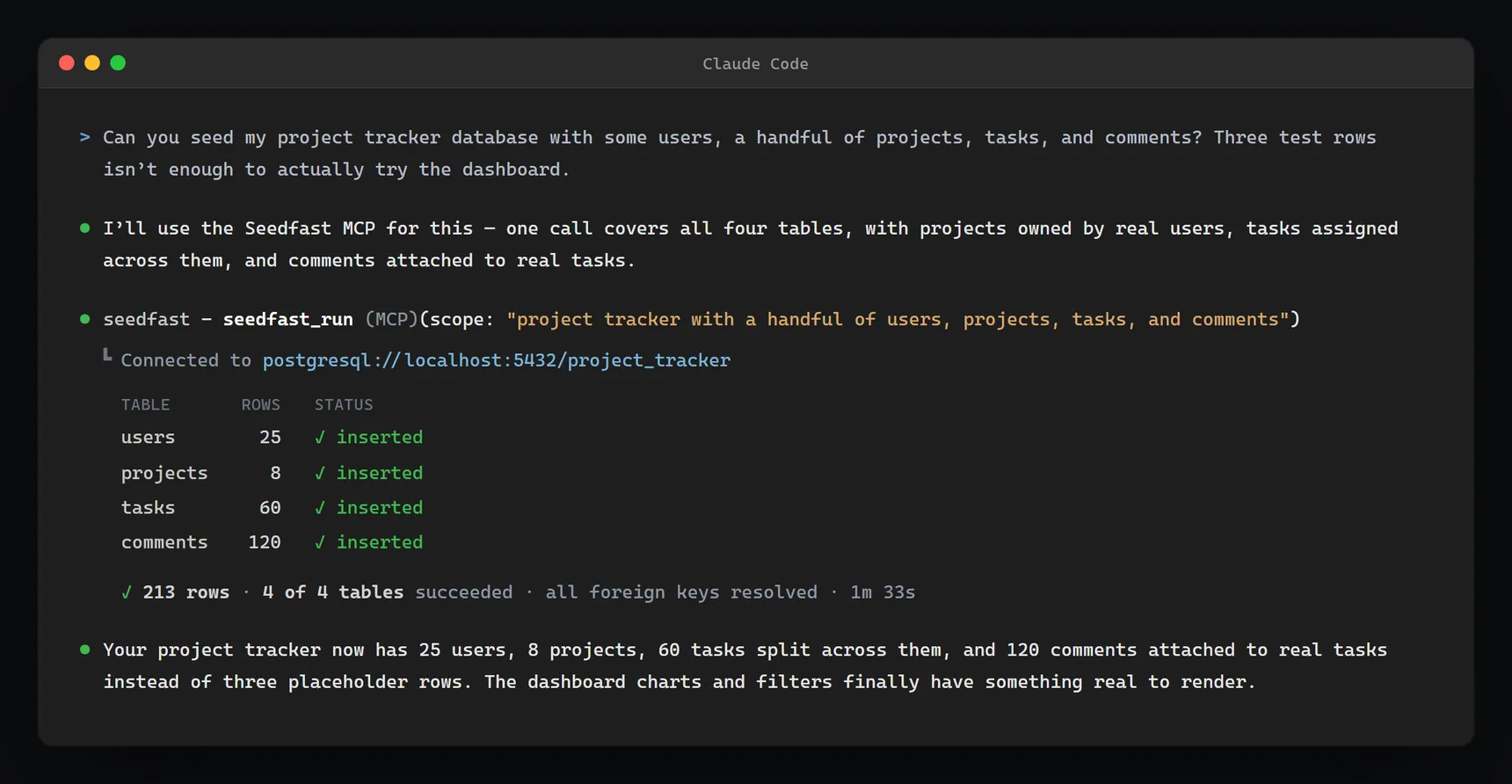
What sets its KIND of MCP apart from the rest of this list is where the work actually happens. Seedfast seeds in place, so the database you connect is the one that fills. Pricing stays flat too, a monthly plan carrying a pool of credits with a free plan under it and no per-token meter, so a seed that fires in CI draws the same as one you run by hand, and because it's CLI-first, the same call the agent makes also drops into a pipeline as a plain command after your migrations. The client config is the same npx block across Claude Code, Cursor, and VS Code; the MCP setup guide carries the per-client version, with focused walkthroughs for Claude Code and Google Antigravity.
Tonic Fabricate's MCP bridges to a hosted agent
Tonic launched a Fabricate MCP on July 1, 2026, and it is a real, capable server. Connect Claude or Cursor to it and you can generate synthetic data without leaving the editor, the same conversational flow Fabricate offers in the browser. Where it differs from an in-place seeder is the location of the work. The MCP hands your request to Fabricate's hosted generation agent, which is metered by credit and token, and the generated data comes back to be loaded, rather than the seed running against the database you're connected to.
Fabricate's reach is the genuine draw. It connects live databases and generates into Postgres, MySQL, Oracle, and Databricks, with exports to formats an in-place Postgres seeder doesn't touch. If your work spans several engines, that breadth is a real reason to pick it. The cost model is the trade to weigh against it. Generation is metered — a free tier carrying $5/month in credits for a personal email or $10/month with every model unlocked for a work email, a Plus plan at $29/month including $25 in credits, then pay-as-you-go around $0.17 a standard turn (tonic.ai/pricing; figures as of July 2026, worth re-checking before you budget). One practical note for anyone hunting the registries — as of July 2026 the Fabricate MCP wasn't listed on Glama, mcp.so, or Smithery, so you add it from Tonic's own docs rather than a one-click install. The longer head-to-head lives in Seedfast vs Tonic Fabricate.
Open-source and community servers
Both registries carry a long tail of community-built servers. Glama alone scans tens of thousands (glama.ai/mcp/servers) and groups the relevant ones under a Databases category, while mcpservers.org keeps a parallel list. Most of what you'll find there is the access kind, though a smaller number aim at generation — SeedBase Test Data, listed on Glama, describes itself as generating FK-consistent synthetic data for a database from an AI assistant (glama.ai/mcp/categories/databases).
For anyone who wants something self-hosted and open-source, the registries are the place to start. Two cautions travel with that choice, though. Quality and upkeep swing widely across a directory that size, so the scan score and the date of the last commit tell you more than the description does. And an agent with a write path into your database deserves the same scrutiny you'd give any dependency, community server or not.
The bigger category is database-access MCPs
The reason the shelf looks so full is that nearly every major data platform now ships an MCP, and they are overwhelmingly access servers. Oracle exposes its database to agents through SQLcl (oracle.com/mcp). Microsoft's SQL MCP Server lets an agent work with tables, views, and stored procedures (Microsoft Learn). From Cloudflare, the Bindings MCP reaches D1 databases along with the rest of the Workers stack (blog.cloudflare.com). DBmaestro's, announced in April 2026, puts release automation and CI/CD orchestration for database pipelines under natural-language control (InfoQ), while Salesforce's surfaces org data and metadata to an agent.
Every one of these earns its place, and not one of them generates test data. They let an agent read, query, or operate a database whose rows are already there. Aim any of them at an empty schema and it has nothing to act on; a generation server is what changes that. Plenty of teams keep one registered alongside an access server, because the day you spin up a blank schema is exactly when the query tools have nothing to say.
Which MCP server should you wire up?
Start from what you actually have in front of you. If the database already holds data and you want the agent to inspect it, query it, or run migrations against it, one of the access MCPs above is the whole answer, and bolting on a generator you'll never call is just clutter in the config.
If the schema is empty — a fresh container, a branch cloned thin, a demo environment with no rows — you need a generation server, and there the choice turns on interface and cost. For in-place seeding of your own Postgres from an agent or a CI step, on flat pricing, Seedfast is the one I reach for, and since I work on it you should read that as a stated interest rather than a neutral ruling. Fabricate's breadth is hard to beat when you're generating interactively across several database engines from a browser or editor. And if you'd rather vet a self-hosted option yourself, the open-source servers on the registries are worth a look. If you're cross-shopping beyond MCP servers specifically, the best database seeding tool roundup covers ORM seeders and standalone generators side by side.
Frequently asked questions
What is an MCP server for test data?
A test-data MCP server is one whose tools generate realistic, relationally consistent rows and write them into a database, so an AI coding agent can populate an empty schema by describing what it needs in plain language. It's distinct from the far more common database-access MCP, which only reads or queries data that already exists. Seedfast is one of the generating kind; it reads your live Postgres schema and writes the connected rows straight into it. The Oracle, Microsoft SQL, and Cloudflare D1 servers are the access kind.
Is there an MCP server that generates data instead of just querying it?
Yes, a few. Seedfast generates connected rows and writes them into your own database in place. Tonic's Fabricate MCP generates through a hosted, credit-metered agent. And a handful of open-source servers, such as SeedBase Test Data on Glama, aim at the same job for self-hosted setups. Most database MCP servers, by contrast, only run SQL against data that is already there, which does nothing for an empty schema.
Does Tonic Fabricate have an MCP server?
It does. Tonic launched a Fabricate MCP on July 1, 2026, and connecting Claude or Cursor to it lets you generate synthetic data from the editor. The request runs through Fabricate's hosted generation agent, metered by credit and token (tonic.ai/pricing), rather than seeding your connected database directly. Registry listings haven't caught up yet, so Tonic's own docs are still where you install it from.
Are there open-source MCP servers for test data?
There are. The Glama and mcpservers.org registries list community-built servers under their database categories, and a few of them, SeedBase Test Data among them, sit on the generating side of the split this page draws rather than the querying side (glama.ai). Coverage and maintenance vary a lot across a registry that large, so check each server's scan score and recent commit history before you connect it to a database it can write to.
Which MCP server is best for database seeding?
The best MCP server for database seeding depends on where your database lives and how you pay. For seeding your own Postgres in place from an agent or a CI pipeline on a flat plan, Seedfast fits that shape (a stated interest — I maintain it). For generating across multiple engines from a browser or editor, Tonic Fabricate's reach is the stronger fit despite the metered cost. If you want to inspect or query an existing database rather than fill an empty one, you don't want a seeding server at all — an access MCP does that job.
The short version
Strip the 870-server shelf down and it sorts into two piles. Almost everything is an access MCP that reads a database already holding rows. A handful generate the rows instead — Seedfast in place on your own database, Fabricate through its hosted agent, a few open-source servers if you'd rather self-host and vet the code. If the problem you keep hitting is the empty schema an agent stalls on, Seedfast's free plan is enough to register one config block and watch a database fill from a single prompt, without a card and without any production data touching the run.
