

Picture a team standing up an evaluation harness for a support agent — the kind that reads an inbox, opens the CRM, and works a queue of tickets. On the first task, the agent is told to merge two duplicate records for one company and confirm the merge by email, and it fails on the opening query. There are no companies in the database, no contacts, no tickets, and every task in the suite bottoms out the same way, on a read that returns nothing to act on.
"Training data for AI agents" is the phrase that search usually begins with, and it turns up labeled corpora, annotation vendors, and datasets of human-graded examples — none of which stands up the thing the agent actually needs, a system with state in it. What is missing isn't a pile of examples to learn from. It is a populated database the agent can read, change, and be graded against.
What "training data for AI agents" actually points at
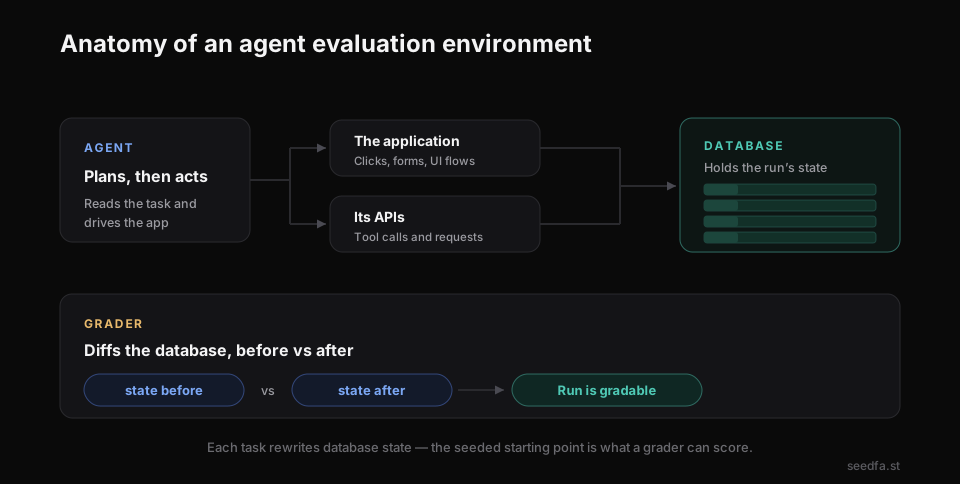
For a model that classifies text or predicts the next token, training data is a heap of examples, and cleaner, larger heaps are most of the game. Agents that operate software are a different animal. When something files a ticket or runs a database migration, the score depends on what happens to a system after it acts, so the thing it trains and evaluates against is an environment made of the application, the database underneath it, the APIs it can call, and a set of tasks whose correct answers are known ahead of time. AI agent training data, in the sense that matters for these systems, is that environment loaded with realistic state, and a spreadsheet of inputs and labels does not substitute for it.
This is why the search results feel off-topic. The benchmarks that research teams actually cite for software-operating agents ship as environments you run, each one carrying a starting state and a grader that inspects the end state after the agent is done. A labeled dataset can tell you whether the agent picked the right intent, but whether it left the database in a correct condition is a question only a running system can answer.
The database is the part that carries the state
Strip an agent environment down to its load-bearing piece and you are left holding the database. Tasks read from it (a query for the oldest unresolved ticket, a scan for every invoice past due) and tasks write back to it, which means a run's success is literally the difference between two database states. The app is a set of doors into that state, and the APIs are handles on it. Take the rows away and none of the doors lead anywhere. The agent told to escalate a stuck order has no order to escalate, and the grader meant to check whether the right row changed has no row to check.
Because every task in a well-built suite is defined as a transformation of state, with a starting condition the environment guarantees and an ending condition the grader verifies, the trustworthiness of the whole evaluation rests on whether that starting condition was set up with rows that relate to each other the way production rows would. An empty CRM can't teach an agent to work a CRM, and it can't test one either. That's the same wall a coding agent hits when it builds a schema and never fills it, then reports every check green because empty tables have nothing to contradict, the failure mode an agent that greenlights its own empty tables walks through in full. For an evaluation harness the stakes flip around, and you want the tables full precisely so the grader has something real to measure against.
Labeled-dataset thinking doesn't transfer
The instinct carried over from model training is to treat data quality as a dial you can leave a little low. A training corpus tolerates a defect rate — mislabel two percent of a sentiment dataset and the model still learns, because the noise averages out and the gradient finds the signal underneath it. Nothing about an agent's database works that way. A schema is a set of hard constraints rather than a distribution to approximate, so a single foreign key pointing at a row that was never created isn't a small error waiting to wash out across thousands of examples — it's a broken insert that halts the load, or a row that violates referential integrity and quietly poisons every task that later reads it.
So "label more examples" is the wrong reflex when an agent has nothing to work against. The gap here is not annotation. It's a schema's worth of connected rows (companies that own contacts, those contacts owning tickets that each carry a history) sitting in the database before the agent's opening move. Hand that job to a model and ask it to write the rows itself, and it will happily reference records it never inserted, because a language model emits plausible SQL rather than verified SQL. Seedfast writes those rows from the schema instead, so every reference in them resolves to a row the same run created.
Repeatable state is what makes eval runs comparable
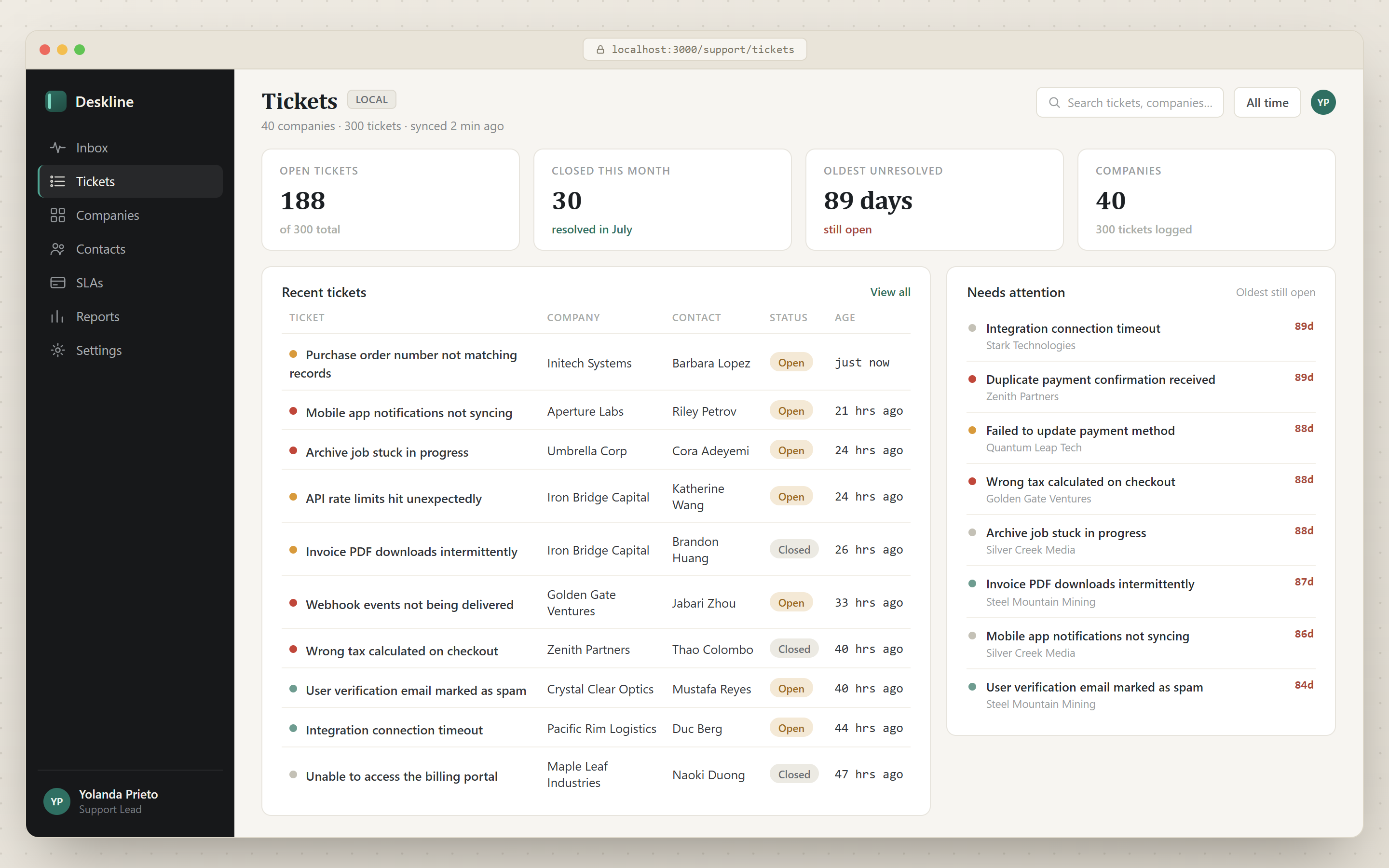
Evaluation piles a second demand on the data, which is that every run has to begin from the same place. An agent evaluation environment earns trust only when its starting state is fixed and realistic; shuffle the rows between runs and the scoreboard stops meaning anything, because a higher score might signal a smarter agent or just an easier draw and you can't tell which. A seeded initial state settles that. Load the same known rows before every attempt and each run faces an identical world, so the only variable moving between runs is the agent itself.
That fixed starting state is also where the grader's ground truth lives. You seeded three duplicate companies, which makes "the agent should end with two" a fact you defined rather than a guess you're checking after the fact. The unglamorous name for standing this up on a real schema is database seeding — the same operation a demo or a staging environment needs, pointed at an agent's world instead of a human's.
Where Seedfast fits
Seedfast is built for exactly this floor, the populated and connected database an agent needs before it can be trained against a task or graded on one. It connects to your application's database, reads the live schema on that connection, and writes fresh rows that come out connected and valid, every child row resolving to a parent that exists. Nothing it inserts is copied from anywhere. You describe the world you want in plain language and it builds it.
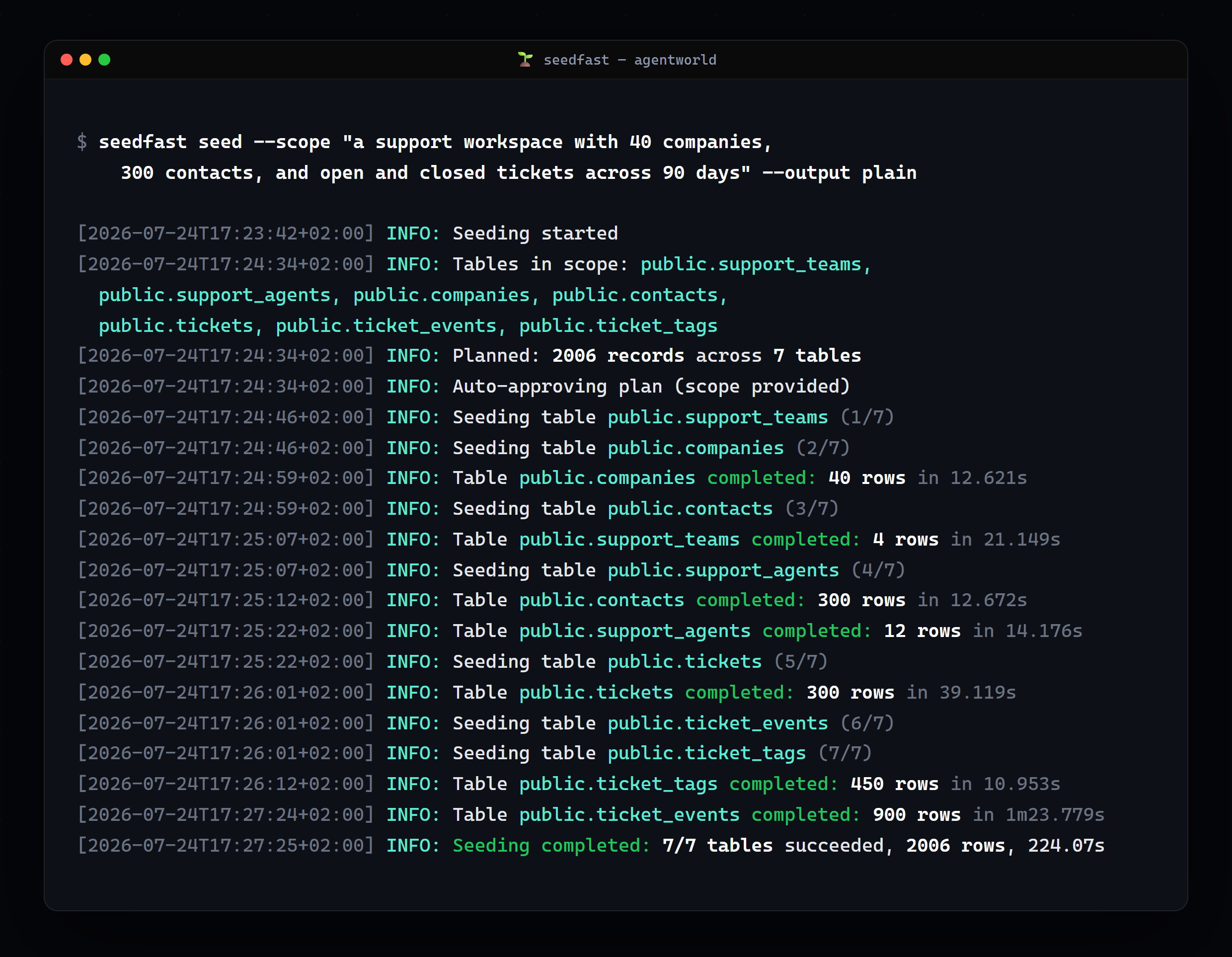
seedfast seed --scope "a support workspace with 40 companies, 300 contacts, and open and closed tickets across 90 days"
One command stands up an entire environment's worth of state, sized to the eval rather than to production.
 A schema is the shape of your tables and not the rows inside them, so the connection exposes table and column names while your real customer data stays out of the picture, which is what lets a regulated team seed a believable world without moving anything sensitive into it.
The detail that matters for an agent pipeline is that Seedfast doesn't have to be a step a person runs by hand. It drops inside a CI pipeline as a single command, and it runs as a Model Context Protocol (MCP) server, so an agent assembling its own harness can call the seed as its first move and provision the world it's about to be tested in. The environment stops being something a human prepares in advance and becomes something the pipeline stands up on demand.
Frequently asked questions
What is training data for AI agents?
For agents that operate software rather than only generate text, training data is less a labeled dataset than a working environment made of the application, the database that holds its state, the APIs it calls, and the tasks whose correct answers are known in advance. The agent learns and is measured by what it does to that environment, so the practical bottleneck is usually standing up realistic, connected state in the database rather than collecting more labeled examples.
Is training data for AI agents the same as a labeled dataset?
Not for agents that act on systems. A labeled dataset fits supervised model training, where each example carries a target output. An agent working a queue of tickets is graded on the end state of a database after it acts, and a static list of input-output pairs can't represent that. The data that matters is the seeded state of the environment it operates in.
Why does an AI agent need a populated database to train against?
Because its tasks read and change database state. An agent told to merge duplicate records, escalate a stalled order, or reconcile an invoice has nothing to do when those rows don't exist, and no way to be graded, since the grader compares the database before and after. Empty tables leave both the agent and the evaluator with nothing to work on.
How is application-database data different from a model training corpus?
A training corpus tolerates some noise, since a fraction of mislabeled examples barely dents a trained model. An application database offers no equivalent slack — one foreign key aimed at a missing row breaks the insert or corrupts every downstream read, because a database enforces constraints instead of averaging over a distribution. Environment data has to be right on the very first row, since there's no average for a bad one to hide inside.
How do you generate the state for an agent evaluation environment?
By seeding the database from its live schema. Seedfast reads the tables and their relationships over the connection, then writes connected rows that satisfy the constraints, so the environment starts realistic and internally consistent. One CLI command does it, or one MCP call, which is what lets an agent pipeline provision the world it's about to be evaluated in.
Stand up the world before you grade the agent
The agent is the interesting part, but nothing can train or grade it until something stands up the world it works in, and that world's floor is a database full of connected, believable rows. No labeled dataset supplies that floor. Seed your first environment against your own schema in a couple of minutes, and when it matches what your agent pipeline needs, the free plan runs without a card before the flat monthly plans take over.
