

A test that talks to Postgres has to get its data from somewhere, and most pytest suites make that call badly. Either every test rebuilds the whole database and the run crawls, or a pile of hand-written setup fixtures drifts away from the schema until one Tuesday migration turns a wall of green tests red. Pytest database fixtures are supposed to be the fix here, not the source of the pain. They're dependency injection for your tests — a way to declare "this test needs a database in this state" and let pytest wire it up. Things go wrong when a fixture quietly becomes the place you park slow I/O or a stack of hardcoded rows.
This guide walks the pieces that decide whether a database suite stays fast and trustworthy, starting with what the fixture scopes actually cost, then the transactional rollback pattern that spares a Postgres suite from truncating tables between tests, then where seeding a realistic baseline belongs so your fixtures stop hauling around data they were never meant to own. Seedfast fills that baseline from the live schema in one command before pytest starts, which is the arrangement everything below is built around. The code assumes SQLAlchemy 2.0 and pytest-django 4.x, the current stable lines of both.
Key Takeaways
- A fixture is dependency injection, not a hook for slow setup. The moment a fixture starts rebuilding a database on every call, the scope you gave it is the whole cost of your suite.
- Scope is the lever nobody adjusts. A session-scoped connection built once and reused is the difference between a suite that finishes in seconds and one that reconnects to Postgres a thousand times.
- Roll back, don't truncate. Wrapping each test in a transaction and rolling it back at teardown gives you a clean slate without touching a single
TRUNCATE, and SQLAlchemy 2.0 makes the recipe short. - Deferred foreign keys are the trap in that pattern — a constraint marked
DEFERRABLE INITIALLY DEFERREDonly fires at commit, and a rollback fixture never commits, so it can hide a broken row your production code would reject. - Seedfast seeds a realistic, schema-consistent baseline once, either locally or as a step before the test job in CI, so pytest's own scoping and rollback handle isolation on top of it. Nothing gets installed into the fixture path, and no test calls out to a generator while it runs.
Why pytest database fixtures go wrong before they go slow
Speed is the symptom people notice, but correctness usually breaks first. A fixture that inserts user_id=42 and asserts against it works fine until another test deletes user 42, or CI starts its sequences from a different number, or two parallel tests both claim the same primary key. The failure message then reads expected 3, got 0 and points at application code that has nothing to do with the real problem, which is that the data the test assumed is gone.
Shared mutable state is the root of nearly all of it. When several tests read and write the same rows, order starts to matter, and a suite where order matters can't run in parallel. A tearDown that deletes what the test created looks tidy until one test raises halfway through, skips its cleanup, and leaves rows behind that quietly poison everything after it. What each test actually needs is a starting state it can trust and a guarantee that nothing it writes leaks into the next one — scope and transactional rollback are how you get both.
Fixture scopes: function, class, module, session
Every pytest fixture has a scope, and scope decides how often the setup and teardown code runs. The pytest docs list five values — function, class, module, package, and session — ordered from narrowest to broadest. A function fixture (the default) is torn down at the end of each test. A session fixture is built once when first requested and destroyed only when the whole run ends.
import pytest

@pytest.fixture(scope="function")   # the default — rebuilt for every test
def payload():
    return {"email": "ada@example.com"}

@pytest.fixture(scope="module")     # once per test file
def api_client():
    client = make_client()
    yield client
    client.close()

@pytest.fixture(scope="session")    # once for the entire run
def engine():
    engine = create_engine(TEST_DATABASE_URL)
    yield engine
    engine.dispose()
For database work the choice is not cosmetic. Building a SQLAlchemy Engine and opening a Postgres connection is expensive enough to dominate the clock on any suite past a few dozen tests, so the engine and any read-only reference data belong at session scope, while the per-test transaction that isolates writes belongs at function scope. The table below is the trade each level makes.
| Scope | Setup runs | Reuse is safe when | Reuse bites when |
|---|---|---|---|
function | Every test | Always — full isolation, no shared state | Never a correctness risk, only a speed one |
class | Once per test class | Tests in the class only read the shared value | A test mutates it and a later one depends on the original |
module | Once per file | The fixture is a connection, engine, or read-only data | Tests in the file write to it expecting a clean slate |
session | Once per run | The value is genuinely immutable or self-cleaning | Any test mutates it — the mutation leaks to every later test |
The pattern that holds up keeps the expensive, stable things at a broad scope and layers a narrow-scoped fixture on top for isolation — the trick behind the rollback pattern below.
The transactional rollback pattern
Here is the single most useful pattern for a Postgres test suite, and the one thin tutorials skip. Instead of resetting the database between tests, you open a transaction before each test, run the test inside it, and roll it back afterward. Postgres then discards everything the test wrote and hands the next test the same baseline it started from, without truncating a single table. A rollback is far cheaper than a TRUNCATE ... CASCADE plus a reseed, so the suite stays fast as it grows.
SQLAlchemy: bind a Session to an outer transaction
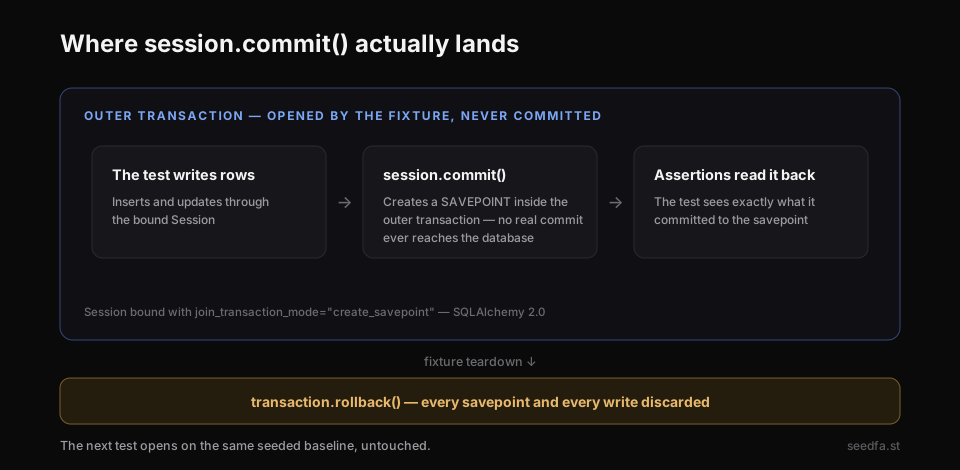
The catch is that ORM code wants to call session.commit(), and a naive setup would commit straight through to the database and defeat the rollback, a problem SQLAlchemy heads off with SAVEPOINTs. You begin a real transaction on a raw connection, bind the Session to that connection, and tell the session to implement its own commit/rollback as SAVEPOINTs inside your outer transaction.
In SQLAlchemy 2.0 this is one parameter. The official recipe for joining a Session into an external transaction passes join_transaction_mode="create_savepoint", and the docs note that the event handlers older versions needed to reset the nested transaction are no longer required.
import pytest
from sqlalchemy import create_engine
from sqlalchemy.orm import Session

TEST_DATABASE_URL = "postgresql+psycopg2://app:app@localhost:5432/app_test"

@pytest.fixture(scope="session")
def engine():
    engine = create_engine(TEST_DATABASE_URL)
    yield engine
    engine.dispose()

@pytest.fixture
def db_session(engine):
    connection = engine.connect()
    transaction = connection.begin()          # outer transaction, never committed
    session = Session(bind=connection, join_transaction_mode="create_savepoint")
    try:
        yield session
    finally:
        session.close()
        transaction.rollback()                # discard everything the test wrote
        connection.close()
A test that uses db_session can insert rows, call session.commit() as many times as its code path needs, and read back exactly what committed — all against a SAVEPOINT. When the fixture tears down, the outer transaction.rollback() throws the whole thing away. Because the engine is session-scoped and only db_session is function-scoped, you pay for the connection a single time while every test still gets its own clean transaction.
pytest-django: the django_db marker
If you're on Django, pytest-django gives you the same isolation without wiring the transaction yourself. Mark a test with @pytest.mark.django_db and, per the pytest-django database docs, it runs inside a transaction that is rolled back at the end — the same mechanism Django's own TestCase uses.
import pytest
from django.contrib.auth import get_user_model

@pytest.mark.django_db
def test_new_user_is_active():
    User = get_user_model()
    user = User.objects.create_user("ada@example.com", password="pw")
    assert user.is_active
This marker has one important exception worth flagging. When your code relies on transaction.on_commit() hooks, or a test spins up the live_server fixture, or you specifically want to assert real commit-and-rollback behavior, the rollback wrapper works against you, because nothing ever commits and those paths never fire. For those cases pass transaction=True, which flushes the database between tests instead of wrapping them:
@pytest.mark.django_db(transaction=True)
def test_email_is_queued_on_commit():
    # on_commit hooks actually run here, because the test really commits
    register_user("ada@example.com")
    assert len(mail.outbox) == 1
The docs are blunt about the cost. Flushing the database between tests runs much slower than rolling a transaction back, so reach for transaction=True only when you're actually testing transaction behavior, and default to the plain marker everywhere else.
The deferred-constraint edge case
Rollback isolation has one failure mode worth knowing before it bites you in production. A foreign key declared DEFERRABLE INITIALLY DEFERRED is not checked when you run the INSERT; PostgreSQL's docs state plainly that "DEFERRED constraints are not checked until transaction commit." A rollback fixture never commits its outer transaction, and even the session.commit() calls inside a test only release SAVEPOINTs rather than committing the top-level transaction. So a row that dangles a deferred foreign key at nothing will sail through a rollback-isolated test and then blow up the first time real application code commits it.
When a test genuinely needs to exercise that deferred check, force it with SET CONSTRAINTS ALL IMMEDIATE at the point you want the constraint evaluated, or run that specific test with real commits via @pytest.mark.django_db(transaction=True) instead of the rollback path.
-- inside the test's transaction, before you expect the check to fire
SET CONSTRAINTS ALL IMMEDIATE;
-- a dangling deferred FK now raises here instead of hiding until commit
Most suites never hit this, because most schemas don't defer their constraints. If yours does — cyclic references between two tables are the usual reason — keep at least one commit-based test on that path so the rollback pattern isn't silently covering for a bug.
Seed the baseline once, not per test
Rollback keeps tests from stepping on each other, but it puts nothing in the database to begin with. Something still has to establish the realistic starting state your integration tests query against — the customers and their orders, the reference tables they join to — and the wrong place to do that is inside a per-test fixture that regenerates it every time.
Seed it once, ahead of the run — one CLI command before you invoke pytest locally, or a step after migrations and before the test job in CI. Seedfast reads your live schema and generates realistic, connected rows that satisfy its constraints, so a single seedfast seed fills the whole database with a baseline your tests can read without you hand-writing a row of it. Pytest's scoping and the rollback fixture take it from there, every test seeing the baseline and rolling back its own writes on top.
# conftest.py — assert the baseline is present, fail loud if it isn't
import pytest
from sqlalchemy import text

@pytest.fixture(scope="session", autouse=True)
def seeded_baseline(engine):
    with engine.connect() as conn:
        rows = conn.execute(text("SELECT count(*) FROM customers")).scalar_one()
    if rows == 0:
        pytest.exit(
            "Test database is empty. Seed a baseline first:\n"
            "  seedfast seed --scope 'a few customers with orders and line items'",
            returncode=1,
        )
That autouse session fixture doesn't generate anything — it checks that the baseline seeded outside the test run actually landed and stops the suite with a useful message if someone forgot to seed. Compare that shape with the alternative some tools push, where every fixture calls out to a generation service at test time and couples your setup to a network call on the hot path. One seed step up front, described in plain English with the --scope flag, keeps generation out of the loop, and the getting-started guide covers seedfast connect and seedfast seed for the first run.
factory_boy vs. raw SQL fixtures vs. schema-aware seeding
These three approaches solve overlapping problems, and the honest answer is that a mature suite often uses more than one. The question is which job each is actually good at.
| Approach | Best at | Cost on a schema change | Foreign keys & constraints |
|---|---|---|---|
| Raw SQL fixtures | Tiny, fixed reference data you rarely touch | Manual edit every migration; drifts silently | You order the inserts and satisfy every FK by hand |
factory_boy | The one specific object a test asserts on | Edit the factory when its model changes | Coded per relationship via SubFactory |
| Schema-aware baseline (Seedfast) | The realistic bulk every test queries against | None, since Seedfast re-reads the schema each run | Handled from the live schema; values aren't repeatable |
Raw SQL fixtures are the fastest thing to write and the first to rot. A hand-maintained INSERT script freezes the table shape on the day you wrote it, and the next NOT NULL column turns it into a failing insert three layers removed from the test. factory_boy earns its place for the object under test — when a test needs "an admin user with a suspended subscription", a factory builds precisely that, with sequences and SubFactory relationships, and reads clearly at the call site.
import factory
from myapp.models import User

class UserFactory(factory.django.DjangoModelFactory):
    class Meta:
        model = User

    email = factory.Sequence(lambda n: f"user{n}@example.com")
    role = "member"
    is_active = True

# in a test: the exact object this test asserts on
user = UserFactory(role="admin", is_active=False)
Where factory_boy stops paying is the background. Populating fifty tables of realistic, foreign-key-valid data so a reporting query has something to run against means hand-defining a factory per table and keeping each in step with migrations — the volume a schema-aware baseline covers without the upkeep. The two are complementary rather than rival. Seed the connected bulk once, build the single asserted-on object with a factory inside the test, and treat it as test data management split by job rather than one tool doing both.
When to seed per-test vs. once-per-suite
Default to seeding once and isolating with rollback. It's the fast path, and it fits the large majority of integration tests, which read the baseline, write a little, assert, and don't care whether their neighbor's rows exist. Session-scoped baseline plus function-scoped transactional rollback is the shape to reach for first.
Re-seeding for an individual test earns its cost only when the test needs a genuinely different data shape than the baseline provides. An empty-state UI test wants a customer with zero orders. For pagination you might need one customer sitting on two hundred, and a permissions test often depends on a specific matrix of roles the baseline doesn't happen to contain. In each of those, build the exact rows with a factory inside a function-scoped fixture, still under the rollback so the special-case data disappears at teardown.
The trap is the middle ground where a suite re-seeds the whole database per test out of caution — that's how a five-minute run becomes forty. If a test queries for "a customer with at least one order" instead of assuming customer 42, it can share the baseline, and most tests can be written that way with a little discipline about not hardcoding IDs. The E2E test fixtures guide works the same principle from the browser-testing side.
Running it in CI
The CI story is short because most of it isn't pytest-specific. You bring up a Postgres service container, gate it on pg_isready so no step races a database that isn't listening, migrate, seed the baseline, then run pytest. The seed step lands last, immediately before the tests read the database. The YAML below uses Seedfast as that seed step; any seed script slots into the same position.
      - run: pip install -r requirements.txt
      - run: alembic upgrade head                     # migrate first
        env:
          DATABASE_URL: postgresql+psycopg2://app:app@localhost:5432/app_test

      - run: npx seedfast seed --scope "a few customers with orders and line items" --output json
        env:
          SEEDFAST_API_KEY: ${{ secrets.SEEDFAST_API_KEY }}
          SEEDFAST_DSN: postgresql://app:app@localhost:5432/app_test

      - run: pytest -q                                # then read the database
        env:
          TEST_DATABASE_URL: postgresql+psycopg2://app:app@localhost:5432/app_test
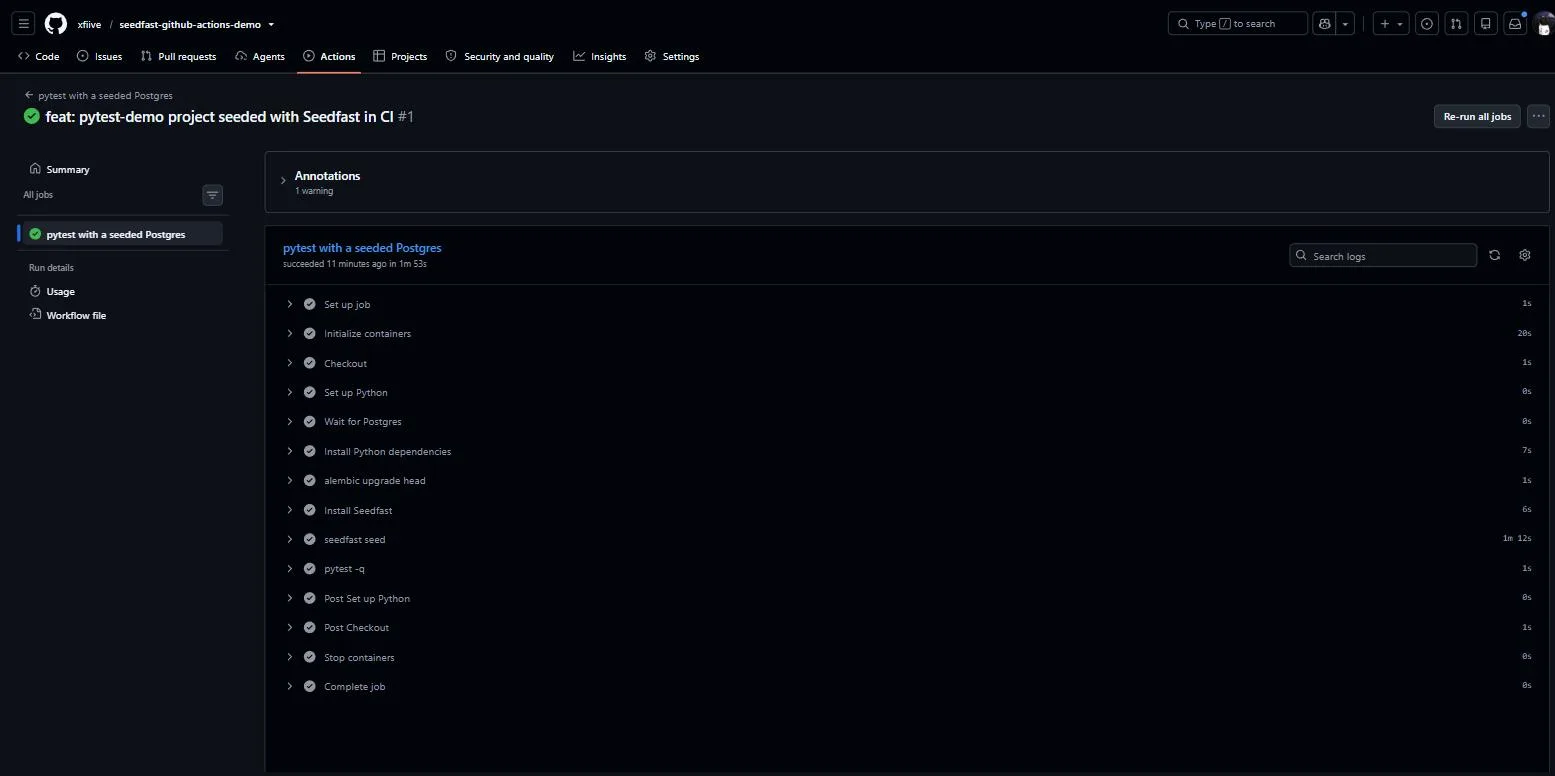
The full mechanics of the service container, the health-check gate, and the migrate-then-seed ordering get their own walkthrough in seeding a Postgres test database in GitHub Actions — there's no reason to repeat it here. The Seedfast-specific CI setup, including the API key and non-interactive scoping, lives in the CI/CD database seeding docs. Whichever way you seed, the running order is the load-bearing part, and this is database seeding applied to a pytest job like any other.
A complete conftest.py, end to end
The complete file below wires together a session-scoped engine, an autouse guard that fails fast when the baseline is missing, and the function-scoped pytest Postgres fixture (db_session) that every test depends on. Drop it at the root of your test tree and the whole pytest test database setup fits in one file: seed once before the run, and each test gets the baseline plus perfect isolation.
# conftest.py
import os
import pytest
from sqlalchemy import create_engine, text
from sqlalchemy.orm import Session

TEST_DATABASE_URL = os.environ.get(
    "TEST_DATABASE_URL",
    "postgresql+psycopg2://app:app@localhost:5432/app_test",
)


@pytest.fixture(scope="session")
def engine():
    """Built once for the whole run — opening connections is the expensive part."""
    engine = create_engine(TEST_DATABASE_URL)
    yield engine
    engine.dispose()


@pytest.fixture(scope="session", autouse=True)
def seeded_baseline(engine):
    """Assert the baseline seeded before pytest ran (locally via the CLI, or a
    prior CI step) is actually present. Fail loud rather than run empty tests."""
    with engine.connect() as conn:
        customers = conn.execute(
            text("SELECT count(*) FROM customers")
        ).scalar_one()
    if customers == 0:
        pytest.exit(
            "Test database is empty. Seed a baseline first:\n"
            "  seedfast seed --scope 'a few customers with orders and line items'",
            returncode=1,
        )


@pytest.fixture
def db_session(engine):
    """Function-scoped session bound to an outer transaction that is always
    rolled back. Tests may call session.commit() freely — it commits to a
    SAVEPOINT, and the outer rollback discards everything at teardown."""
    connection = engine.connect()
    transaction = connection.begin()
    session = Session(bind=connection, join_transaction_mode="create_savepoint")
    try:
        yield session
    finally:
        session.close()
        transaction.rollback()
        connection.close()
A test then reads like plain application code, and the isolation is invisible:
def test_order_total_sums_line_items(db_session):
    customer = db_session.execute(
        text("SELECT id FROM customers LIMIT 1")
    ).scalar_one()

    db_session.execute(
        text(
            "INSERT INTO orders (customer_id, status) "
            "VALUES (:cid, 'open') RETURNING id"
        ),
        {"cid": customer},
    )
    db_session.commit()  # commits to a SAVEPOINT, not the real database

    open_orders = db_session.execute(
        text("SELECT count(*) FROM orders WHERE status = 'open'")
    ).scalar_one()
    assert open_orders >= 1
    # teardown rolls the outer transaction back — the next test never sees this order
Run it, and the moment the fixture tears down, the order this test created is gone. There's nothing to clean up or truncate, and the baseline the whole suite reads against sits exactly as seedfast seed left it.
Frequently asked questions
Do I need a pytest plugin to seed a database?
No. Seeding and test isolation are separate jobs, and pytest already handles the isolation half natively through fixture scopes and transactional rollback. For the seeding half you only need something that fills the database before the run — a CLI command locally, a step in CI — not a plugin wired into your fixture path. Seedfast runs as that one seed step and leaves the fixtures to pytest, so there's nothing extra to install into the test process itself.
What's the difference between a pytest fixture and database seeding?
A fixture is a pytest construct that provides a test with what it needs and cleans up afterward — a connection, a session, an object under test. Seeding is the separate act of putting a realistic starting dataset into the database before any of that runs. A fixture can assume the seeded data exists and query it, but it shouldn't be regenerating that dataset on every test, which is what makes a suite slow.
Should I use transaction rollback or truncate tables between tests?
Prefer rollback. A rollback discards the test's writes in one step, while a truncate-and-reseed pays table-by-table I/O between every pair of tests. With SQLAlchemy's join_transaction_mode="create_savepoint" your ORM code can still call commit() freely inside that rollback. Truncation is only the better tool when you must test real commit behavior (on_commit hooks, visibility across connections), which is exactly the case pytest-django covers with @pytest.mark.django_db(transaction=True). When it is, every table belongs in one statement rather than a loop, a list the TRUNCATE generator writes from your schema.
Does factory_boy replace database seeding?
Not for the bulk of your data. factory_boy is excellent for building the specific object a test asserts on, with sequences and SubFactory relationships. It's a poor fit for populating fifty foreign-key-linked tables of realistic background data, because that means writing and maintaining a factory per table against every migration. Seed the connected volume once with Seedfast, which reads the live schema and fills those tables for you, then use factory_boy for the one-off object each test cares about.
How do I seed a Postgres test database for pytest in CI?
Run the seed step after migrations and before pytest. Bring up a Postgres service container, gate it with pg_isready, apply your migrations, then run npx seedfast seed against the CI database with SEEDFAST_API_KEY and a connection string, and finally invoke pytest pointed at the same database. The GitHub Actions guide covers the container and health-gate mechanics, and the CI/CD database seeding docs cover the key and non-interactive scoping.
Where to take it from here
The shape that holds up is layered. At the bottom sit a session-scoped engine and a baseline seeded once; on top of them, function-scoped transactional rollback provides isolation while a factory handles the single object a given test asserts on. Get that stack right and your fixtures stop being a maintenance surface — they go back to being plain dependency injection, which is all they were ever meant to be.
If the "seed a realistic baseline once" step is the piece you're missing, point Seedfast at a local or CI database and let it read the schema and fill it. The getting-started guide takes you from seedfast connect to a seeded database, and the free plan doesn't ask for a card.
