

You open the tool, and it wants a decision before you have said what the data is for. Generate the rows, or pull from what is real? Synthetic data vs real data gets framed as a head-to-head with one durable winner, so people go hunting for whichever source is generally safer or more faithful. No such winner exists. The comparison resolves only once you name the job the data is being hired for, because the property that makes a dataset excellent for one job barely registers for another.
Most of the muddle comes from treating real as the default and synthetic as the fallback. Production data carries real authority, since it actually happened, but it earns its keep on one class of work and means little on another. Sort the work into two lanes, and the stalemate breaks.
Synthetic data vs real data starts with the job
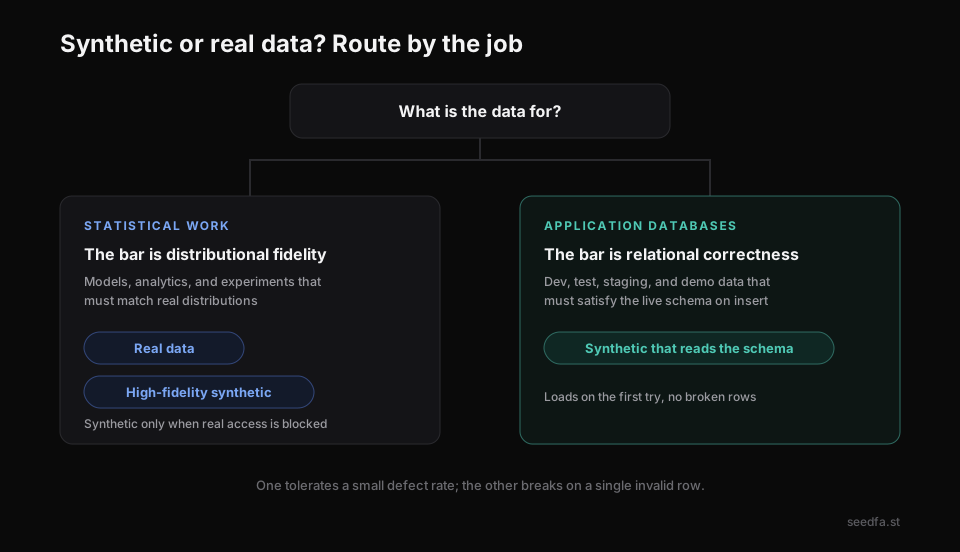
Almost everything anyone generates or copies a database for lands in one of two lanes, and the lanes want opposite things.
The first is statistical work, the training and evaluation of machine-learning models and the analytics beside them. Here the data stands in for a population, so what matters is that its overall shape matches reality closely enough. Correlations between columns hold, the numbers carry real skew, and a one-in-a-thousand case turns up about once in a thousand rows, and a few wrong rows in a set of millions do no damage, because the model reads the mass and not the exception.
The second lane is the application database, the one your software connects to while you build against it, test it, stage it, or demo it — a lane that answers to a schema rather than to a distribution. Every foreign key must land on a row that exists; miss a constraint or leave a required column empty, and the database refuses the write and the work halts. So, a real-world distribution becomes a bonus here; validity against the schema is what the lane demands.
The dividing line is error tolerance
Underneath the two lanes sits the reason they diverge - a training corpus and an application database forgive mistakes at wildly different rates. Give a model a batch in which a small percentage of rows are wrong, and it still learns the pattern that dominates; the bad rows blur into noise the training averages over, and if the data improves later, the model improves with it. However, an application database grants no such margin, and a single row whose foreign key points at a customer that was never inserted is not an error to be averaged away - the insert is refused, the load stops there, and every test that expected that row fails for a reason unrelated to the code under test. Moreover, a statistical workload can name a defect rate it tolerates and run below it and a relational one has no rate to name.
In the statistical lane, real data usually wins
For work that feeds a model or a dashboard, real data holds a genuine edge, because you are chasing fidelity and real data is fidelity by definition. It carries the correlations nobody thought to encode and the messy tail nobody would have invented. When you can get it, and are allowed to use it, real data is often the right call for lane one.
The catch lives in those two conditions: production data comes wrapped in access controls for good reason, and pointing a training pipeline at raw customer records is the exposure those controls exist to prevent, and it ages, since last quarter's snapshot describes a business that has moved on. Yes, it hands you only the cases that occurred, so a model needing thousands of examples of a rare fraud pattern gets the handful real data has and no more. Synthetic data is built for exactly that opening, producing as many rare cases as a model needs and carrying no real record. So, its weakness here is fidelity itself, the hard problem the fidelity-first synthesis platforms and open-source synthesizers spend their engineering on. The honest read on synthetic data vs production data in lane one is that synthetic wins when access is blocked or rare cases are scarce, and loses when its fidelity falls short of the real distribution.
The application lane flips the answer
Populate a database your application runs against and the calculus inverts. Fidelity stops being the point; correctness against the schema becomes the whole of it. You need a dataset where every reference resolves and every constraint holds, so the app boots and the tests run instead of dying on a bad insert. Real production data can clear that bar, but dragging a copy into a development or staging environment looks safe and is not. It brings the exposure problem back where the controls are weakest, a full clone is heavy enough to slow every reset, and it drifts from the schema the moment someone ships a migration the dump predates. It also cannot manufacture the case you need on demand, since production has the customers it has, not the five hundred with a canceled subscription and refunded order your edge-case test wants.
Synthetic data is the natural fit here, with one caveat that trips teams up. A generator filling each column from its own source of randomness hands you a users table and an orders table that look perfect alone and do not connect, order rows pointing at customer IDs that were never created, which a real foreign key rejects on the first insert. Why believable values are the easy half while making the rows connect is the hard half is the subject of how synthetic generation actually works end to end; the deeper version, where a reference resolves and still means nonsense, runs through what coherent data really demands. Some teams split the difference by masking a production copy, which trades one set of headaches for another and sits beside the other options in the seeding-tool landscape. Real data, for all its authenticity, is out of place in this lane, and naive synthetic data fits the lane while still breaking the schema. Seedfast reads the live schema before it writes anything, which is why every orders row it produces points at a customer created in the same run.
The comparison, by job
Laid side by side, the two lanes ask nearly opposite things of the same two sources.
| Question | Statistical lane (models, analytics) | Application lane (dev, test, staging, demos) |
|---|---|---|
| What the data stands in for | a population's distribution | a schema the software runs against |
| The bar for "good" | distributional fidelity | relational correctness |
| Cost of one wrong row | absorbed into a defect rate | halts the insert and every test after it |
| Real data's main liability | access limits, staleness, no rare cases on demand | exposure risk, size, drift, no edge cases on demand |
| Synthetic data's main liability | fidelity gaps against the real distribution | naive generators that ignore the schema |
| Usually the better source | real, or high-fidelity synthetic when access is blocked | synthetic that reads the schema |
Read it down a column for your job, not across a row for a winner. If the data feeds a model or a report, start from real and turn to synthetic when access rules or missing rare cases force it, then judge what you generate on how faithfully it reproduces the distribution. If it populates an application's database, start from synthetic and hold it to one standard above the rest, that every row satisfies the schema. The synthetic vs real test data decision comes down to exactly that. Doing it well is its own discipline, the one database seeding covers, and the AI-driven options are ranked in the AI generator comparison.
Where Seedfast fits, and where it doesn't
Seedfast works one lane. It is data infrastructure for the application database, the development, testing, staging, and demo environments where relational correctness is the bar and a copy of production is a liability. It connects to a live PostgreSQL database, reads the current schema, and generates connected, referentially consistent rows that fit it, so a child row lands on a parent that exists rather than on an ID that was never created. Describe what you want in plain language and it fills the database in one command:
seedfast seed --scope "500 customers with orders, payments, and a realistic spread of account ages"
Because those rows are invented from the schema and never sampled from production, no production access is required and no production rows are involved, which is why a generated dev or staging database sidesteps the copy-of-production liability above. That is a consequence of generating rather than copying, not a compliance claim. Seedfast is not built for lane one; it does not train your models or feed an analytics warehouse a replica of production statistics, work that wants a different tool and a different definition of good.
Frequently asked questions
Is synthetic data as good as real data?
It depends entirely on the job. On statistical work, where fidelity to a real distribution is what counts, carefully sampled real data is the benchmark and synthetic is judged by how near it gets. On an application database, where all that matters is that every row satisfies the schema, a copy of production is more hazard than help and well-formed synthetic data wins outright.
Does synthetic data work for training machine-learning models?
Yes, and that is squarely lane one. A model learns the pattern that dominates its training set, so it tolerates a defect rate that would wreck an application database, which is why generated data can train a working model even when it is imperfect. Two things decide how well it works. One is how faithfully the synthetic set reproduces the real distribution, rare cases included. The other is whether you validated the result on held-out real data rather than on more synthetic data.
Can I just use a copy of production for my test database?
You can, and plenty of teams do, but it hides its costs. A production copy carries real customer data into environments with weaker controls, weighs enough to slow every reset, and goes stale the day someone ships a migration. Worse for testing, it holds only the cases that already happened, so the edge case your feature needs may not be there at all. The synthetic data vs production data trade-off usually favors generating the rows you need over importing the ones you have. Seedfast generates them against the schema your database has at that moment, which is the one thing a copy taken last month cannot do.
When is real data the right choice?
Whenever the job is statistical and you are cleared to use it. Model training, evaluation, and analytics all read the aggregate and absorb a few odd rows, so they benefit from the fidelity only real data carries for free. The two gates are permission and freshness; fail either and high-fidelity synthetic data steps in.
Match the source to the job
The reason "synthetic data vs real data" stays unsettled in the abstract is that it was never one question. It is at least two, wearing the same words. Sort your work into the statistical lane or the application lane, check which property decides quality there, and the choice that felt like a coin toss turns fairly obvious. For the application lane, where a single dangling reference takes down the whole run, Seedfast reads your live schema and generates connected data without touching production. Run your first seed in a couple of minutes, or read the pricing first, a free plan that asks for no card and then flat plans at $16 and $69 a month.
